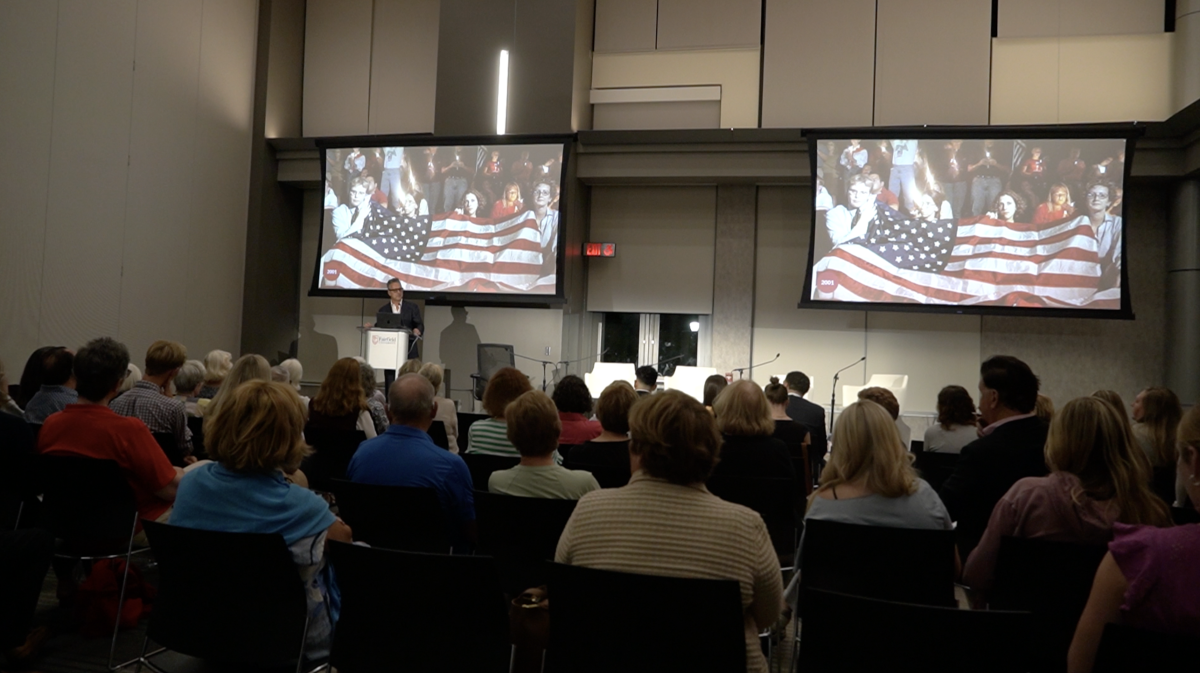
It’s not every day that the Harvard Kennedy School Institute of Politics Director of Polling gives a presentation at Fairfield University. But on September 19, pollster and author John Della Volpe visited campus to discuss Gen Z’s unique political journey and their continuous contributions to America’s political atmosphere.
In a conversation with The Rearview before the event, Volpe shared his experiences speaking with Gen Z voters in focus groups and having the opportunity to engage them on a personal level. He explained that demonstrating attention and active listening during these lighter conversations makes it easier to delve into more serious topics.
One question Volpe would always ask his focus group participants was “What keeps you up at night?” The question was always met with problems like student debt, family issues, and affordable housing, which, as Volpe explained, can help the voter begin to connect the dots and learn about some kind of civic engagement that can help them.
When asked what he hopes listeners take away from his talk, Volpe said that he hopes people learn to ask questions. Gen Z is voting in numbers double that of a younger Gen X, and are still about 50% undecided. He explained that young voters don’t realize their influence and unique perspective and it’s important for them to tune in to the political climate of the country.
Volpe began by saying his speech wouldn’t be like other traditional presentations. Instead of charts and graphs, he compiled a series of photos. He explained that the images would help understand the important perspective Gen Z brings to politics and how it developed.
Gen Z has had a different experience and has witnessed a vastly different America than previous generations. It is generally understood that Generation Z covers those who were born between 1997 to 2012.
Volpe explained that the last time the United States was truly united was after the September 11 attacks in 2001. Gen Z has never experienced connection as a nation, and has seen arguably the most political divide in America since the Greatest Generation, born from 1901 to 1927, Volpe said.
Beginning with images from 2008 and leading up to present day, Volpe mapped out the various times of political divide and chaos in the nation. Estimating that Gen Z were most likely first introduced to their parent’s views or news on the TV anytime from 2008 to 20011, Volpe explained that this was a chaotic political time period with division between parties and the Occupy Wall Street movement gaining momentum.
The early 2010s were particularly traumatic with the Sandy Hook shooting in 2012 and the opioid epidemic. Volpe shared a personal story about his daughter in relation to the opioid epidemic. “My own daughter, when she was sixteen, attended two wakes in one day. One for a classmate, and one for a teammate’s mother, both of which were related to opioids.”
Volpe mentioned that the number of youth suicides spiked 57% nationally in the years after 2009. He also found in a study from Harvard that about 50% of students deal with anxiety, depression, and hopelessness daily.
The rest of the 2010s decade leading up to 2020 was a time of political chaos and violence highlighted by mass shootings, such as the Pulse Nightclub shooting in 2016, the 2017 Mandalay Bay shooting and the 2018 Parkland High School shooting.
The early 2020s were impacted by the COVID pandemic, Black Lives Matter protests, national and global political unrest and record adolescent homelessness. Throughout the presentation, Volpe showed charts with young voter participation after traumatic national events occurred. He found that young voters participated on average 30% to 60% more when they cared deeply about the issues at hand.
He then shifted focus to the upcoming election, mentioning the constantly fluctuating polls between former President Doland Trump and Vice President Kamala Harris. “It’s important to reach young people, not just through political channels, but cultural channels as well,” Volpe argued.
He concluded the conversation by explaining that politics isn’t talked about enough with younger people because it’s considered taboo in today’s world, but it’s important to have conversations about politics and civic issues because they shape the future Gen Z will live in.
The event ended with a discussion panel featuring student leaders Andrew Mejia, Grace Lanigan and Amari Rodriguez. FUSA president and Junior Andrew Mejia was one of the student panelists. Mejia mentioned his surprise at Gen Z’s impact, especially in the upcoming election.
“I think a lot of my friends don’t know how engaged they can be and it was surprising to hear how much of an impact we can have,” Mejia said.
Senior Grace Lanigan noted students’ lack of political engagement on campus. “There’s generally a political apathy,” Lanigan said while hoping for a change.
Erin Detlefsen, a first-year and audience member, resonated with Volpe’s presentation as a young voter. “It was interesting to see everything on display like that, considering I lived through it, not thinking about each moment.” Detlefsen also said that she hopes to get her friends involved in voting in this upcoming election.
Connor Donnan ‘28 also shared the same reaction, stating that Volpe had discussed the issues “in a way that I’ve not heard before.”
“I think he actually understood where students like us are coming from,” Donnan punctuated.