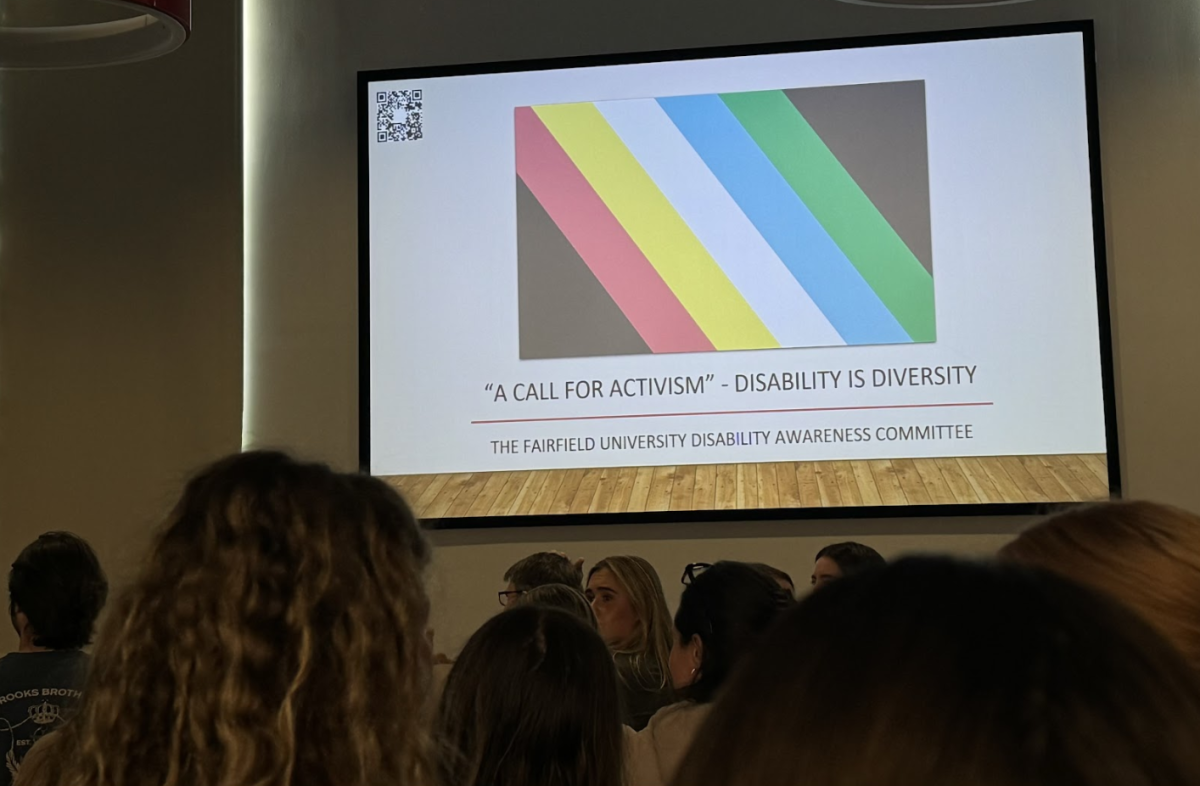
Members of the new Disability Awareness Committee are asking students and faculty of the Fairfield University community to lead with inclusivity and be an ally. They hope to create a more equitable campus culture in the classroom and beyond.
The committee, led by 26’ Newman Civic Fellow Christopher “Tripp” Lyons, shared a message of disability awareness on Tuesday evening at their “A Call for Activism— Disability Is Diversity,” event in the Kelly Center.
Office of Accessibility Assistant Director Jillian Murray used her opening remarks to express hope for a “courageous conversation,” setting a tone of learning, honesty and respect.
The night consisted of an information-driven presentation by Lyons followed by a panel discussion with questions from the audience.

Throughout his speech, Lyons explained why disability awareness is needed and important, what disabilities are, and some the barriers faced by people with disabilities- specific to Fairfield University. He concluded his remarks with actionable steps for faculty to make their classrooms a more welcoming environment for students of any ability.
While elaborating on the need for disability awareness, Lyons revealed that the number of students with disabilities has increased in the past few years, especially since the COVID-19 pandemic. He believes it is crucial to be educated on issues of accessibility to build a campus community designed for all.
Lyons explained that not all disabilities are visible, with many students having invisible disabilities.
He explained, “This can sometimes give the impression that it’s only a few people with disabilities that we see on campus. However, it’s an issue that impacts way more people than we think.”
To highlight the growth of students with disabilities at Fairfield, Lyons used data highlighting the rising number of accommodation requests per year. He revealed that in the fall of 2020, there were 1,572 requests. In 2021 that number jumped to 2,550. In 2022 there were 2,754 requests. Last year, the number of accommodation requests passed 3,300 and this fall, there were 3,189 requests.
He also connected the cause with the school’s Jesuit mission.
Lyons said, “As students and staff at a Jesuit institution, we are called upon to uphold these values. We hear about these a lot, and yet, we as a community have some flaws in the ways that we serve people with disabilities.”
He included information from the Americans with Disabilities Act to explain that disabilities by definition are, “A physical or mental impairment that substantially limits major life activities.”
Lyons noted that there are many types of disabilities including intellectual, learning, medical, physical, psychiatric, speech and language disabilities.
He described that visible disabilities are often respected more in academic settings. He said that as someone with a mobility disability, he rarely has a hard time getting his accommodations taken seriously by professors.
“Students with invisible disabilities can be devalued in classrooms, and this is a major reason why we need this campaign.”
Lyons went on to discuss ableism and microaggressions which are discriminatory to people with disabilities. He explained that these can be intentional or unintentional. In one instance, Lyons said you should always ask before helping someone with a disability.
“From experience, sometimes I’m able to do something, but it looks like I am struggling when I am not. So this may be why you’re told no, even when it looks like they need help.”
He continued to say, “People with mobility disabilities, and generally, all disabilities are not inspiring just because we do everyday activities like going to school, work, etc.”
Lyons says universal design is a way to remove the separation between disabled and able-bodied peers in classroom settings. One example of universal design is making a test take home for everyone rather than just students with accommodations to help all abilities.
Finally, Lyons listed ways to make classrooms compatible with the goals of universal design. He included making all class materials accessible (digital textbooks, slideshows and supplementary readings), ensuring captioning on all class videos, utilizing Blackboard Ally, and using inclusive language on class syllabi to create an atmosphere where students feel comfortable seeking help. He discouraged the usage of scanned readings as students who rely on screen readers cannot read them.
Lyons ended by saying, “Remember, people with disabilities are human, treat us that way.”
Following Lyon’s presentation was a Q&A-style panel with students and faculty. One major subject of this portion of the event was disclosing one’s disability to professors at the beginning of each semester.
Some students on the panel said they preferred meeting in person with their professor to get on the same page right away, while others noted that it can be tiring to always have to be a self-advocate.
One idea offered by faculty panelists included disability awareness videos along with the other freshmen year training.
A professor in the audience asked if it would be beneficial for professors to send out a Google Form at the start of a semester. A form could allow students to tell them what tools or accommodations they need to learn best, while not feeling singled out or responsible for setting up different meetings with each professor.
Student panelists reacted positively to this suggestion.
One said, “I always appreciate when professors reach out after they get my accommodation letter… I do like the idea of having a Google Form for students who may not feel comfortable talking with their professor and I think that could be a really good thing for faculty to implement.”
Dr. Emily R Shamash, a faculty panelist from the Educational Studies and Teacher Preparation departments gave insight on how she tries to create a safe environment for students from the first day of class.
Shamash said she has a slide included in her first class materials each year that encourages students to reach out with information so she can help them feel supported in her class.
She said, “I just have in big bold letters: communicate with me, because I can’t support what I don’t know, and I think—I hope— that opens things up.”
The speakers also encouraged viewers to utilize on-campus resources.
For help with questions or accommodations students can visit the Office of Accessibility, the Counseling Center, the Health Center, the Center for Social Impact and the Office of Student Diversity and Multicultural Affairs.