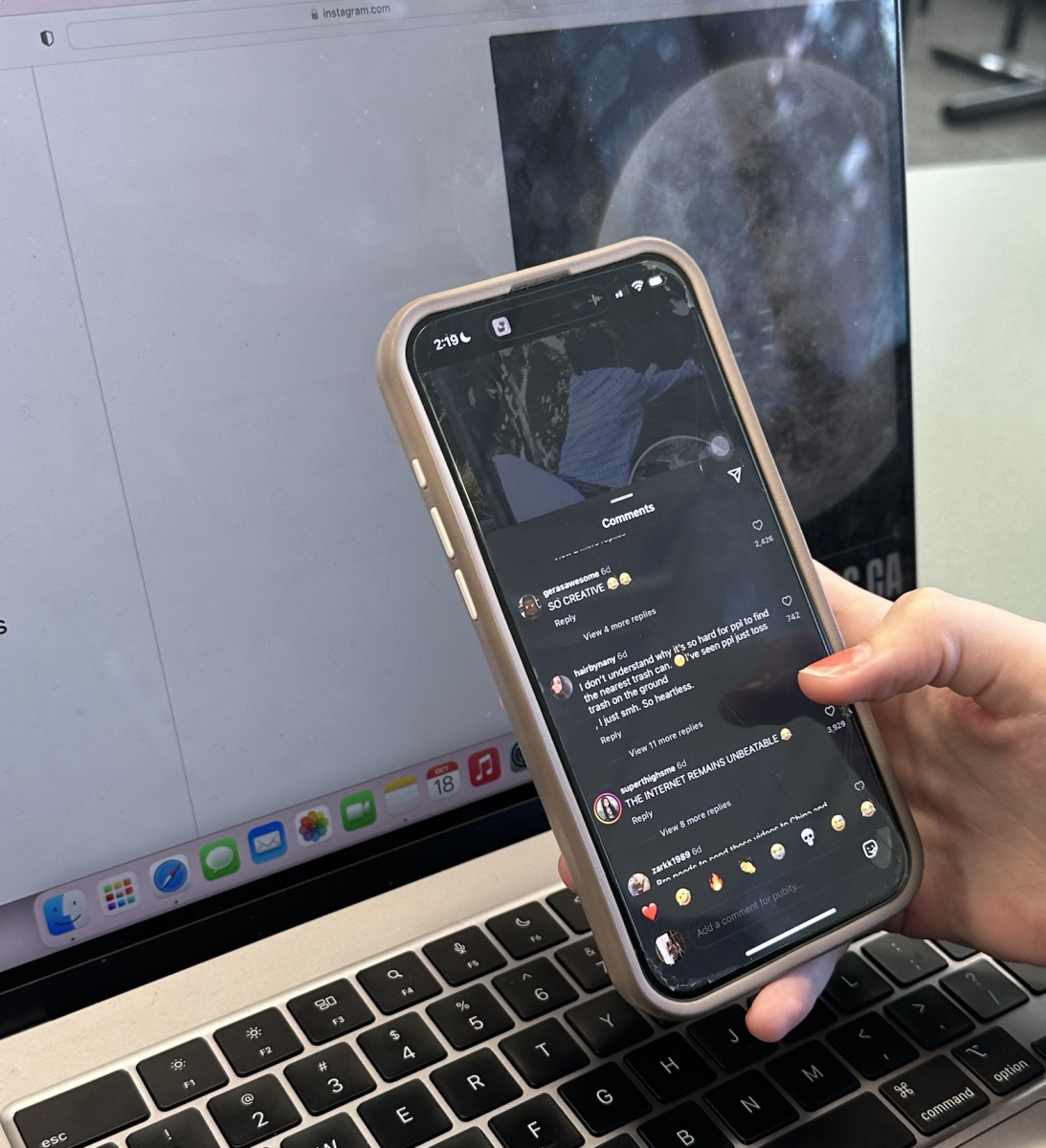
Ever entered a classroom that was completely silent? Maybe you walked in and everyone was glued to their phone or laptop.
If you have felt this way, you are not alone. This is an increasingly common situation many college students find themselves in. In times of social discomfort or unfamiliarity, some students use their phones as a social crutch.
Regardless of whether you see yourself as an extrovert or an introvert, it is hard to ignore the way cell phones have altered human communication.
In times of anxiety, uncertainty or awkwardness, many turn to cell phones as a way to escape. College campuses can be difficult to navigate socially, especially with the ever-expanding digital presence that gives us a safe alternative to avoid socialization.
Sophomore Gabriel Duraes says that he often finds himself going on his phone rather than starting a conversation with a stranger.
“If no one’s talking and nothing’s going on [in a classroom], I take my phone out and doom scroll on TikTok,” said Duraes.
Duraes added that he will talk to people in his classes if he knew them previously, but it is unlikely that he will introduce himself to people he does not already know.
Sophomore Sofia Varino, a self-proclaimed extrovert, says otherwise.
“I’m a very social person. I love socializing with my classmates,” Varino expressed. “I always make an effort to introduce myself… but I feel like a lot of people are very shy before I say something to them.”
Varino admitted to feeling more uncomfortable sitting in silence than she does striking up conversation, though she admits that she too leans on her phone at times.
“If I’m in an uncomfortable position I tend to gravitate towards my phone. I’ll even look at the weather app if I need…to like, have a distraction from the awkwardness.”
Even the most social of people will use social media as a support system when they are uncomfortable. The question is: how much reliance is too much?
Professor Kandice Green, a new visiting assistant professor, explains that it is sensible for students to feel attached to their phones.
“It’s a socializing equipment or tool, to show people that you do have a sense of credibility, popularity, humanity… that you are a whole human outside of the element or the physical space that you’re in,” said Green.
Green is a media psychologist. Her research seeks to understand how people engage with media, as well as how people engage with each other. Dr. Green added that she understands why students see their phones as a reprieve, especially when the classroom is eerily quiet.
Professor Green posed a very interesting scenario of this behavior persisting far beyond college campuses.
“When I go to a restaurant and I look around… and I see people sitting at a four-top, all four people are on their phones or I see three people are on their phone and one person is not. What does it say to that one person who’s not on their phone? If everybody else is on the phone…now it’s a peer-influenced conditioning situation,” explains Green.
Decades ago, when technology was less prevalent in our culture, students were forced to put their pride aside and strike up a casual conversation. Some students, like Varino, definitely still make an effort to be outgoing. Yet a good portion of people will succumb to the subconscious pressure of the phone in their pocket.
The mentality seems to have shifted to, “if everyone else is on their phones, maybe I should be too.”
Yet, when asked, all students shared that they flourish more in an open environment and classroom.
Sophomore Grace DiMarco made the point that it is “not a comfortable environment to do group work either…in a class where nobody is speaking to each other.”
The social norms are changing with the times. Students may not converse with strangers, but why would you when you have access to your best friend at your fingertips? Perhaps things will not persist this way, or perhaps students will become even less social as time goes on.