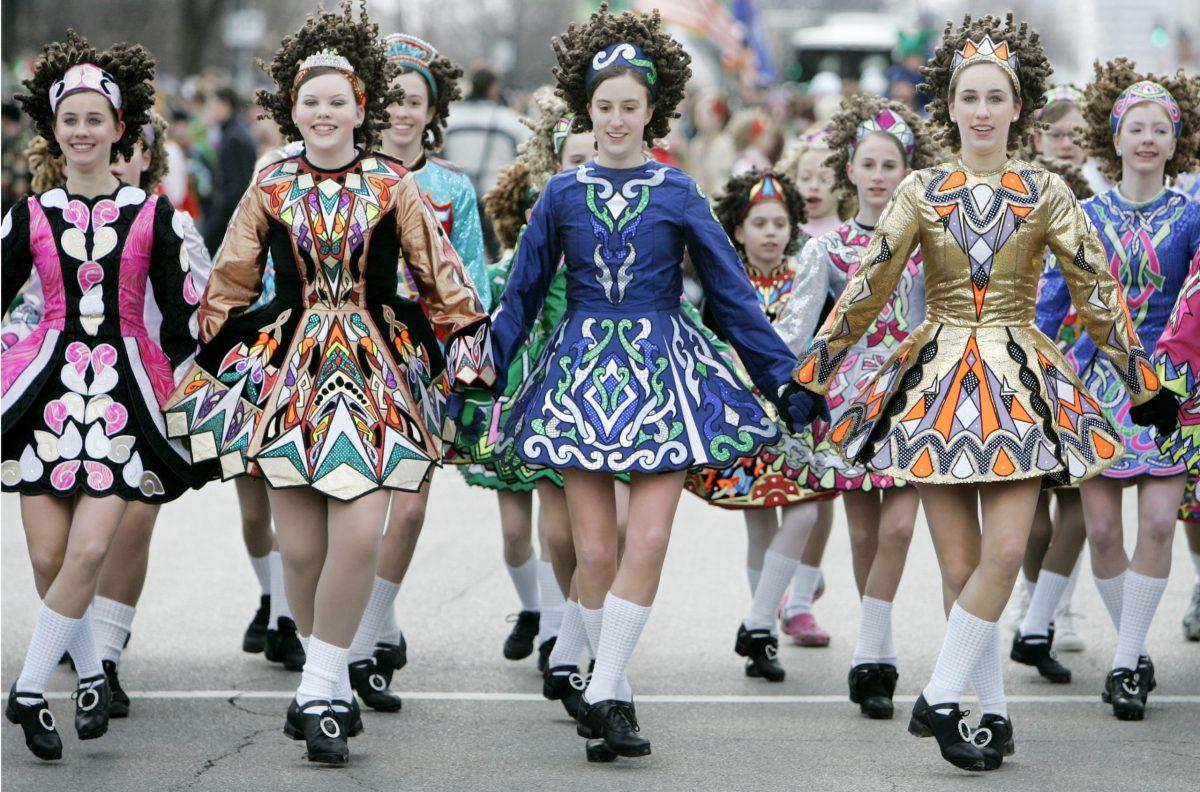
Members of the Sheila Tully School of Irish Dance perform Saturday, March 17, 2007, during the 52nd Annual Chicago St. Patrick's Day Parade. (AP Photo/M. Spencer Green)
Each year, Irish dancers across the country prepare for their own version of March Madness–the Saint Patrick’s Day flurry of performances. Walk into a restaurant or pub at the right time, and you might run into a group of Irish dancers, undoubtedly decked out in some form of green. But the Irish dance season doesn’t end at the close of the month; for many, the competitive season lasts year round and for some, March means preparing for the World Irish Dance Championships on top of any Saint Patty’s festivities. Behind the curls and the shoes are endless practices, demanding workouts and dedicated teachers and dancers that make up the world of Irish dance.
The Saint Patrick’s Day season shows off the more casual performance side of Irish dancing, but many are unaware of the competitive side. In just a few weeks, thousands of dancers will take to the stage to compete in the World Championships. For Irish dancers, this is of similar importance to the Olympics. This is not the only Irish dancing competition, though. Local competitions, called feises, can occur almost any weekend of the year. Irish dancing combines the athleticism of a sport with the grace and creativity of the arts. What comes to mind for most people when picturing Irish dancing might be a little leprechaun doing a jig, but there’s a lot more to it than that. Dancers must have the stamina and strength to lift themselves onto the tips of their toes, to jump high enough to hang in the air and to kick their legs all the way up to their noses, all while keeping their arms and back straight.
Despite its name, Irish dancing is not just for the Irish. Dancers from America, England, Ireland, Australia and many more countries have adopted the sport. They will come together to compete against one another at the World Championships. There will be several different categories at this and other competitions, but three common ones include traditional set, ceili and solo dances.
Traditional set is a classic form of Irish dance, one that pays homage to steps and songs that have been passed down through generation after generation. All dancers in this category will perform, by themselves, a particular dance to a particular song, which are the same for all dancers regardless of school or location.
In contrast, the ceili is a group dance, with various numbers and configurations of dancers who move and work together and around one another to create a synchronized pattern. The goal here is to look as if the dancers are moving as a unit; they want to be perfectly aligned, but this is made more difficult by the fact that they are not allowed to turn their head and check where the rest of their team members are. They have to rely on muscle memory and peripheral vision to stay organized. This is also the only category that permits dancers to move their arms, as the dancers hold hands with their partners.
Finally, the solo dance is maybe the most anticipated and competitive category of the competition. The solo dance involves each dancer competing by themselves in multiple rounds, including a hard shoe dance, named for the shoe with a solid, tappy sole; a soft shoe dance, named for the ballet-like shoe; and if they have placed highly enough to be recalled to the next round, their set dance. The set dance is like the traditional set in that it is performed to a commonly known song, but each dancer’s set will be personalized, choreographed to highlight their strengths and show off what they do best. This is a dancer’s showpiece; it is their opportunity to grab the judges’ attention and convince them that they deserve to stand on the top of the podium.
While many dancers around the world prepare for the Saint Patrick’s Day and competition frenzy, dancers here at Fairfield will be preparing for the Fairfield University Dance Ensemble performance of “A Love Letter to FUDE.” The Dance Ensemble consists of many styles of dance, including Irish. The performance will be March 29 at 6:00 p.m. in the Quick Center for the Arts. If the festivities of the Saint Patrick’s Day season just aren’t enough, be sure to come by and check out the show!