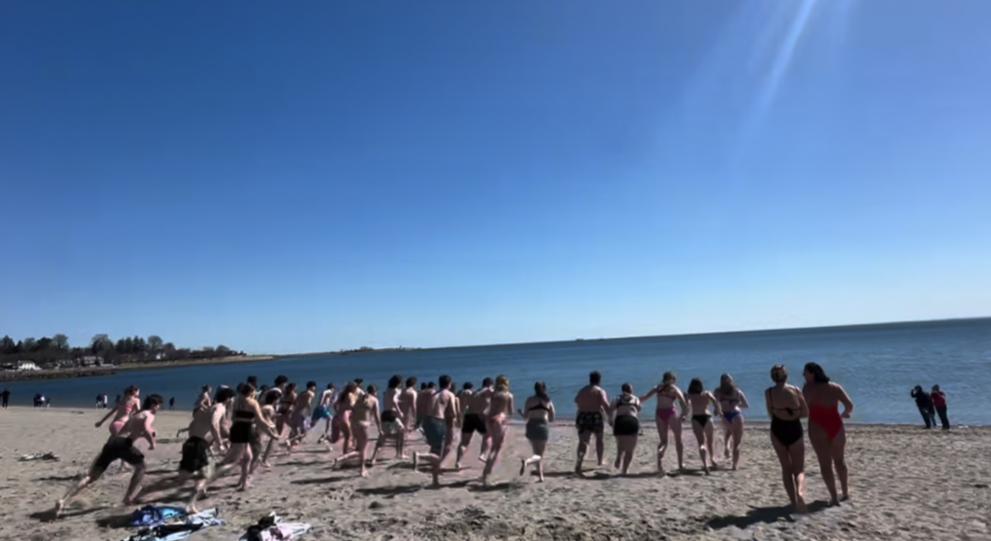
Early Sunday morning, dozens of Fairfield University students flocked to Jennings Beach to participate in a “Polar Plunge” put on by FUSA. While the event itself garnered significant support— contributing more than $1200 toward a larger $ 30,000 goal to fund additional AED devices across campus— many questioned why the university was unwilling to fund such an important and potentially lifesaving mission.
The goal of the Polar Plunge was simple: to raise money for an initiative aimed at introducing AEDs to a number of important university buildings. These consist of residence halls and academic buildings which presently have no such devices. For $40, students could purchase tickets to the event— a group dive into the frigid Long Island Sound— with a portion of the price going toward a commemorative crewneck.
Senior Andrew Caslin, a fourth-year FUSA senator and leader of the initiative, detailed the importance of the project and what FUSA aims to accomplish.
“This is an initiative that I’ve been pursuing for a few years now,” Caslin said. “It would see additional AEDs placed around campus because currently there aren’t any in any of the residence halls, and none in Dolan, Canisius, Donarumma or any of the academic areas either.”
He noted that the devices themselves are extremely intuitive, requiring no training or background to use. “The units that we’re gonna be purchasing are kind of foolproof,” he joked. “It’ll talk you through the entire process of preparing the patient, where to put the pads on a person’s chest and then it’ll analyze that person’s cardiac rhythm and decide whether or not a shock is advisable. It’ll also coach you through CPR, which is really good.”
Caslin explained that the process of getting this project approved has been ongoing since his sophomore year. As he describes, it began after a discussion he had about health and safety training in his residence hall. “I was talking with some RAs about their training,” he noted, “and I found that they weren’t trained in CPR or first aid or at the time Narcan.” While Narcan has since become a part of RA training, Caslin notes that attempts by FUSA to incorporate the others have seen little success.
After nearly two years of conducting research and planning, Caslin and FUSA brought a proposal to the university administration. “The list that we’re looking at now includes 23 units across all of the res halls, two for the Dolan School of Business, Canisius, Donnarumma, McCauliffe and Bellarmine,” he explained. “That estimate comes out close to $30,000…which comes out to between $1200 and $1300 for each [AED device].”
In response, the university accepted the proposal but affirmed they would not fund the initiative. As Caslin recalled, “The consensus there was, you [FUSA] start fundraising and we’ll [Fairfield University] do a bulk purchase of however much you can raise by the end of the semester and install them hopefully around residence halls first.”
In a statement provided to the Mirror by Vice President of Marketing and Communications Jennifer Anderson, the administration responded to questions about their lack of monetary support for the initiative:
“As part of the University’s commitment to heart health safety,” Anderson explained, “Fairfield has invested in 30 AEDs located in key areas throughout campus. Fairfield University has AEDs located throughout campus in locations that present higher risk due to large crowds, age or various functions like athletics and recreation. In addition, the Department of Public Safety (DPS) carries portable AED devices in their vehicles… Fairfield University commends our students for spearheading an initiative to raise awareness of AEDs and to fundraise for additional units, and endorsed this student-led initiative.”
For many student participants at this weekend’s fundraiser, though, the action by the university was seen through a different lens. Senior Grace Sarian attended the Polar Plunge with a friend and expressed her dissatisfaction with the university shortly after the event.
“It’s ridiculous that they don’t have it [AEDs in residence halls] and that it has to be student-funded,” Sarian responded, surprised by the fact that such campus buildings didn’t have AEDs or similar devices already. “But I am happy to be helping a good cause and hope that the AEDs will be useful.”
For Sarian, the resolution to this problem was simple. She argued, “They should pay Nemec less or something.” To her point, Senior Emily Trainor, Sarian’s friend and event participant, responded jokingly, “I would quote Gwen Stefani and say that’s bananas.” In 2023, public records show that Fairfield University president Mark R Nemec was paid more than $850,00.
Senior Jenna LaRochelle, a licensed EMT and Fairfield senior on the pre-med track spoke to the importance of having AED devices on campus in an interview. She explained, “[AEDs] are extremely important to have on campus in accessible places because survival chances are much higher in cardiac arrest when they are used in combination with CPR.”
LaRochelle continued, expressing her frustration with the university’s spending more directly. “The fact that FUSA had to raise money via a fundraiser that relied on student donations is pitiful,” said LaRochelle, echoing the sentiments of a number of Fairfield students. “As a private institution, we should have enough money to purchase a life-saving device. While I understand they are expensive, the school raised almost $4 million last week- maybe we should consider using those donated funds for something like AEDs,” she believes.
That figure references this year’s STAGiving Day on Mar. 19, an annual fundraiser put on by the university that raised nearly $4 million from members of the Fairfield community and alumni for university programs and initiatives. The funds were raised by different entities on campus for their respective departments.
While STAGiving Day was the most recent notable fundraising effort by the University, it paled in comparison to the larger $50 million donation to the university by alumnus and University Trustee John Charles Meditz ‘70— the largest single donation in Fairfield’s history. This, and others like it, add to a longstanding trend of monetary contribution in the form of gifts, grants, contributions and membership fees, totaling roughly $183 million since 2018, per the university’s financial records.
Fairfield University’s undergraduate class sizes have been consistently increasing annually to record numbers for the better part of a decade. Most recently, roughly 5,300 students were admitted to the class of 2029. In large part resulting from contributions made in recent years, the university’s annual financial statement reported nearly $800 million in net assets at the end of the fiscal year 2023.
Though the need for independent fundraising for this initiative proved to be disappointing to many students who attended the event, Caslin has a more optimistic approach. “Right now we’re sitting with $1,200 bucks in our GoFundMe,” he noted before Sunday’s event, “and [the Polar Plunge] is hopefully gonna produce maybe another $1,200 or $1,500.”
Looking forward, FUSA has no plans to hold another fundraising event for the AED initiative. “We’re gonna gear more towards asking for donations from other campus organizations if anyone has leftover money at the end of their season or in the budget,” Caslin explained as he closed the interview, “ I think we’re also gonna reach out to the alumni, board of Trustees or any folks who might have interest in helping.”
FUSA has started a GoFundMe page that interested readers can use to support this initiative and learn more about its progress. The Mirror reached out to Vice President for Marketing and Communications Jennifer Anderson but did not receive a comment on time for publishing.