





Last week, Fairfield University released its “Class of 2029 Profile,” which showcased admission statistics and figures for the incoming first-year class. With an admission rate of 25% from a total applicant pool of 21,290, the more than 5,000 admitted students are poised for another record-setting year as university class sizes continue to grow.
Figures like these— while impressive and representative of a growing interest and recognition of Fairfield— demonstrate a continued approach by the administration that prioritizes prospective classes over the experience and well-being of current tuition-paying students.
Being a senior at Fairfield involved in countless activities over the past four years, I have seen it all firsthand. The evolution of both the culture and student experience here in that time is one that I have become particularly aware of. As much as I cherish the last four years I’ve spent here and dread the day I don a cap and gown on Bellarmine Lawn, I worry that this trend of exponential growth without substantive change is one that only bodes poorly for future classes.
Over the course of the spring semester, The Mirror has written a number of stories about actions taken by the university that are detrimental to student life, almost all of which are fundamentally tied to an overpopulation of students on campus.
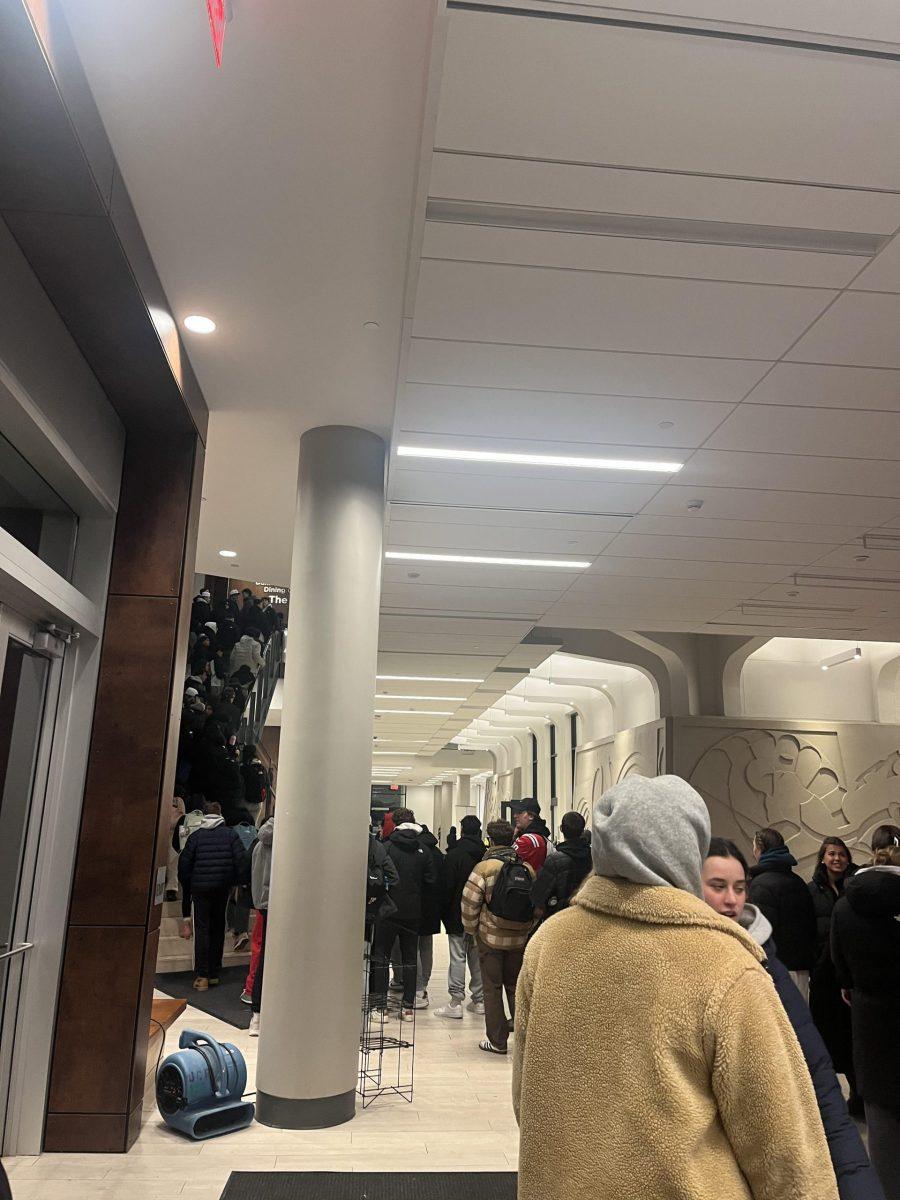
In February, The Mirror covered the overcrowding of university facilities, namely the surge in RecPlex visitors and the overwhelmed mailroom that considered adjusting its schedule to accommodate more student deliveries. In March, this trend continued as we discussed the increase in parking tickets and boots on campus, tied to a new parking system implemented this year. Last week, I covered a Polar Plunge fundraiser for an initiative that the university was unwilling to fund that would see AED units placed in residence halls and academic buildings where there aren’t currently any. Though unique in their scope, each of these stories is directly tied to an increase in student population and the failure of university administration to respond accordingly.
Most recently, the issues of course registration and the campus housing lottery have become concerns at the forefront of students’ minds. While neither of these issues are necessarily new, it is obvious that introducing more students to this equation could only serve to worsen it.
In terms of housing, increasing rates of triples and quads in rooms that were originally designed for two students, sophomores living in what have traditionally been first-year residence halls, juniors living in the Barnyard townhouses, and plans to transition a wing of the Media Center into student housing for Fall 2026 clearly demonstrate the fact that the university does not have the facilities to handle a growing population.
Year in and year out, registration brings to light the glaring reality that there is not enough academic space on campus, either. Overflowing classes barely have enough room to accommodate the population. Though the immense generosity of alumni like John Charles Meditz may offer a glimmer of hope or an answer to these concerns, it begs a more important question. Must we rely on the generosity of our donors to get by? If so, will it even be enough?
Over spring break, news of the university’s most recent renovation plans broke in what is the most significant and disappointing change thus far. This renovation, which has yet to be officially announced but has been communicated to university faculty, will see more than a quarter of the book collection and 56 seats dedicated to student study spaces on the second floor of the DiMenna-Nyselius Library removed to make room for six additional classrooms, as reported by The Mirror’s Sophia Cossitt-Levy.
I cannot express how valuable the library space has been to me as a student. Over the last four years, I have watched it become more crowded and heard more students complain about the lack of resources. The thought of removing so much valuable space is one that I truly cannot shake.
Not only were plans to renovate the library sudden, they were also organized without the oversight of the Educational Planning Committee or the Library Committee, as Prof. Sonya Huber explains in her “Save the Stacks!” document that details the university’s renovation plans and advocates against them. Though Prof. Huber has gathered statements from a number of students and faculty members against the implementation of this plan, no apparent progress has been made toward changing the decision. As such, we must ask ourselves, if the library is so easily devalued by the university, what’s next?
This Saturday, April 5, will see the first of two “Fairfield in Focus” events for accepted students at the university. With it comes a stark reminder of the impacts of a seemingly ever-expanding student body as spaces and resources all over campus shrink. At the current rate, even if the size of the Class of 2029 does not break another record, the university’s enrollment will likely have increased by more than 1,000 students since 2021, as detailed in the Office of Institutional Research’s 2024–2025 Fact Book.
Though I won’t be here to see it firsthand, Fairfield’s uncertain future is one that concerns me. There is so much about this university that I have come to love over the last four years, but I fear that we stand to lose it if substantive change cannot be realized.