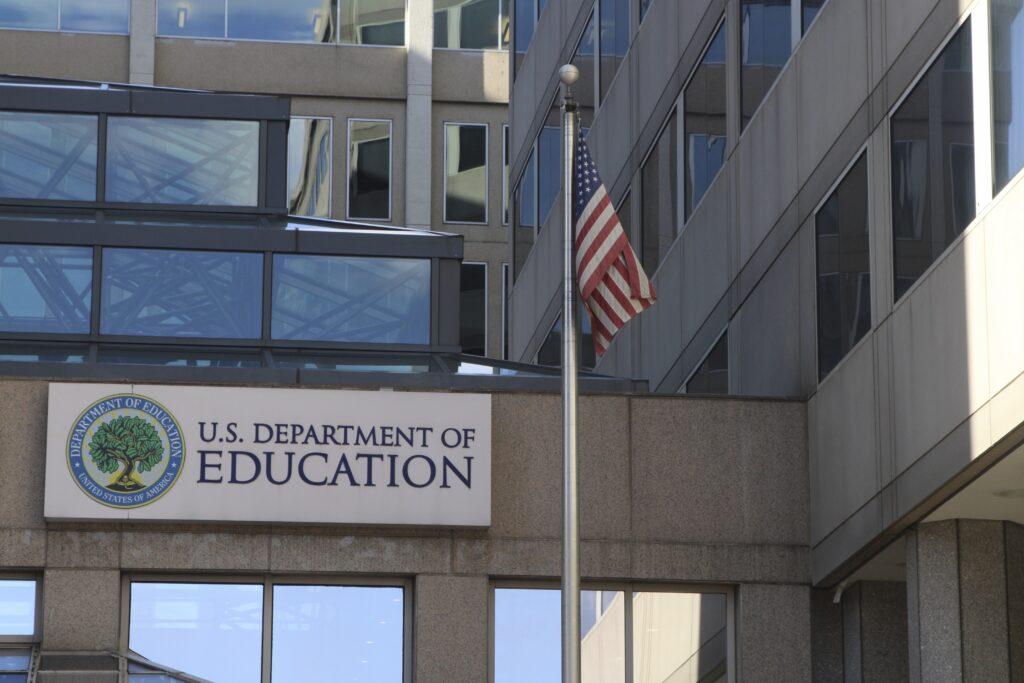
Signage for the U.S. Department of Education - Federal Student Aid Office at 830 First Street NE Washington, D.C., USA, on November 28, 2023. Federal Student Aid is part of the U.S. Department of Education and is the largest provider of student financial aid in America. More than 1,400 employees help make college possible for more than 10 million students each year. (Photo by Carlos Kosienski/Sipa USA)(Sipa via AP Images)
Last month, President Donald Trump signed an executive order titled “Improving Education Outcomes by Empowering Parents, States, and Communities,” which marked the beginning of his administration’s plan to shut down the Department of Education.
While an executive order alone is incapable of shutting down the agency— requiring Congressional approval to fully dissolve the department— this order initiated a reduction in force (RIF) which impacted nearly half of the workforce. Per a Mar. 11 press release, this RIF included 572 employees who accepted voluntary resignations while the rest were placed on administrative leave.
Central to the order’s argument is the belief that the department “has entrenched the education bureaucracy and sought to convince America that Federal control over education is beneficial.” Though targeted more directly at national K-12 education and the dissolution of diversity, equity, and inclusion in curriculum, students at Fairfield University will not be immune to the impacts of the department’s dismantling.
While there may be some merit to the claim that public education in the United States does not rank among the top nations globally, per studies by the Pew Research Center and National Center for Education Statistics (NCES) in 2024, the impact of this decision to effectively dissolve the department extends far beyond that scope. For private institutions like Fairfield University, the ripple of a dismantled Department of Education is one that may prove to be devastating for many students who rely on its function to survive.
The most notable role of the Department of Education for private institutions is the dissemination of federal student aid through FAFSA, student scholarships, and Pell grants. While the president’s executive order claims it will pass these responsibilities onto other government agencies, it’s difficult to imagine a smooth transition for a facet of higher education with a history of devastating impacts for students in the wake of even minor disruption. Pair this with the fact that Elon Musk’s Department of Government Efficiency has been debilitating countless agencies across the federal government with sweeping layoffs, and this transition running smoothly becomes even more challenging to imagine.
Just last year, the introduction of a newly updated FAFSA caused chaos for students and families in need of financial aid. Though the Trump administration claims that “no employees working on core functions of the Free Application for Federal Student Aid were impacted by the recent mass layoffs,” the destruction of the agency would see their function greatly impacted.
The National Association of Independent Colleges and Universities (NAICU)— of which Fairfield’s President Mark Nemec is an active board member— released a statement shortly after the Trump administration’s Mar. 20 executive order, which read:
“Our membership will be focused on how any proposals impact students and families and the smooth operation of the federal student aid program, which so many rely on to access the college or university that best meets their educational goals. The recent challenges with the FAFSA showed all Americans how important the smooth delivery of student aid funds is to our nation and how quickly processes can break down.”
I spoke with Sonya Huber, an English Professor at Fairfield whose research and passion for higher education has made her uniquely aware of Fairfield’s current state. “You can’t go a day in higher ed without reading about the demographic cliff,” she explained in an interview, describing an ongoing threat to colleges and universities that has seen a continuous decline in enrollment over the last decade. A study released by NCES emphasizes this point directly, finding that institutions have collectively seen more than a 15% decline in enrollment over the last 15 years.
Despite this, though, Huber noted that Fairfield has “done well in the face of declining college enrollment by having these like bumper crop classes,” referring to the trend of record-breaking class sizes accepted to the university in recent years.
Though Fairfield University spends roughly $5 million annually on student grants and scholarships, per their financial records, this aid is not nearly enough to sustain a student body that relies heavily on federal grants and funding to attend the institution. As Trump’s executive order acknowledges, the department is responsible for managing a student loan debt portfolio of $1.6 trillion and $60 billion of taxpayer money for federal school funding.
While the Trump administration claims these actions to dismantle the Department of Education aim to bolster the United States’ public education system, it grossly overemphasizes the agency’s shortcomings. In reality, the department that the administration regards as some “woke,” bureaucratic powerhouse spent just $268 billion in 2024— representing a mere 4% of all federal spending as reported by the Office of Budget and Management and U.S. Department of the Treasury.
While there are reasonable criticisms that can and should be levied against the department, this executive action will prove to have immensely harmful consequences that will far outweigh the benefits. As a Fairfield student who has relied on FAFSA and federal financial aid for the last four years and experiences firsthand the impacts of their disruption, I can confidently say that I could not attend this institution without them. For fear of diversity, equity, and inclusion, this action threatens to harm myself and the more than 10 million students who benefit from federal financial aid programs every year.