








Early Monday, Cardinal Kevin Farrell, Camerlengo of the Holy Roman Church, announced the passing of Pope Francis due to a stroke. In what has been the culmination of ongoing health issues stemming from a chronic respiratory illness that has plagued the pontiff for decades, his death marks the end of a 12-year papacy, the fifth longest reign since the turn of the 20th century, led by history’s first Latin American pope.
Imagining a post-Franciscan papacy, members of the religious community must now contend with the Pope’s legacy and its continuation. Senior Andrew Caslin, a senior member of Fairfield’s campus ministry, reflected on the pontiff’s passing as he looked forward and contended with his own faith.
“I am deeply saddened by the passing of Pope Francis. He’s been the only pope I really remember and have grown up with,” Caslin explained, “I hope his legacy as the first Jesuit pope and instilling many of the Order’s values through his papacy will be long lasting; and his dedication to helping the marginalized will continue to inform the Church moving forward.”
In a recent statement released by Fairfield’s President Mark R. Nemec, PhD and Rev. Paul Rourke, S.J. on the afternoon of the pontiff’s passing, the university also acknowledged the importance of the Jesuit Francis’ papacy. “Of course, as part of the Jesuit family, we felt a special bond with the first Jesuit pope,” the statement noted, “Before his election, nobody thought it possible that a Jesuit would be chosen. In everything he did, he showed himself to be a man of Ignatian spirituality.”
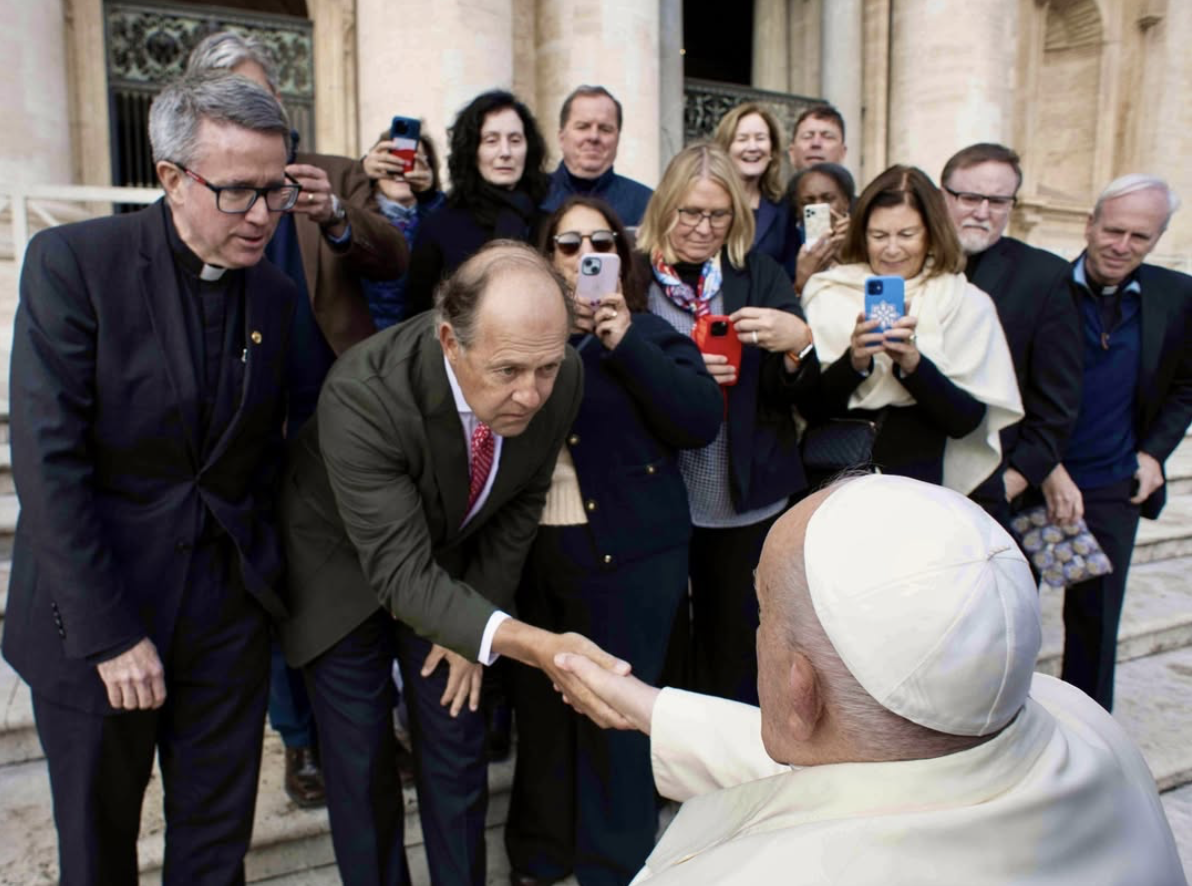
In November, President Nemec group of university officials and members of Fairfield’s Jesuit community traveled to Rome on a pilgrimage to meet with the pope and visit a number of important religious sites. As Nemec and Rourke noted in their statement, this visit was “one of the greatest privileges of our lives. We were all deeply moved by the goodness of this man and felt the presence of God in his company.”
Current Fairfield students and alumni also took to social media to express their appreciation for the late pope and acknowledge the importance of his legacy. Responding to posts across Fairfield University’s social media platforms, one Instagram user commented, “[Francis’] legacy and message of love, kindness, and unity will be felt and missed.”
Others responded on the University’s LinkedIn and Facebook pages with messages like “He has earned his place with our Lord! But, Lord, we will miss him!” and “He would have loved Fairfield University…I know you will carry on his legacy.”
Francis’ health concerns made national headlines in February and have been looming in Rome since. The Mirror covered his admission to Gemelli hospital on Feb. 14 for a respiratory emergency which evolved into a case of double pneumonia and left the Bishop of Rome hospitalized for 38 days, per Vatican News.
During a period of immense uncertainty surrounding Pope Francis’ initial hospitalization, Rev. John Savard, director of Campus Ministry at Fairfield University, reflected on his legacy and the significance of the late pope for both Jesuit education and the larger religious culture fostered during his papacy.
“I think that Francis really helped pull the church into our hearts,” he explained in an interview with The Mirror in February. “How do we feel with the world this broken?…We can kind of categorize what’s wrong and what’s right. But I think what Francis really did was help us connect with it [Scripture] at a feeling level.”
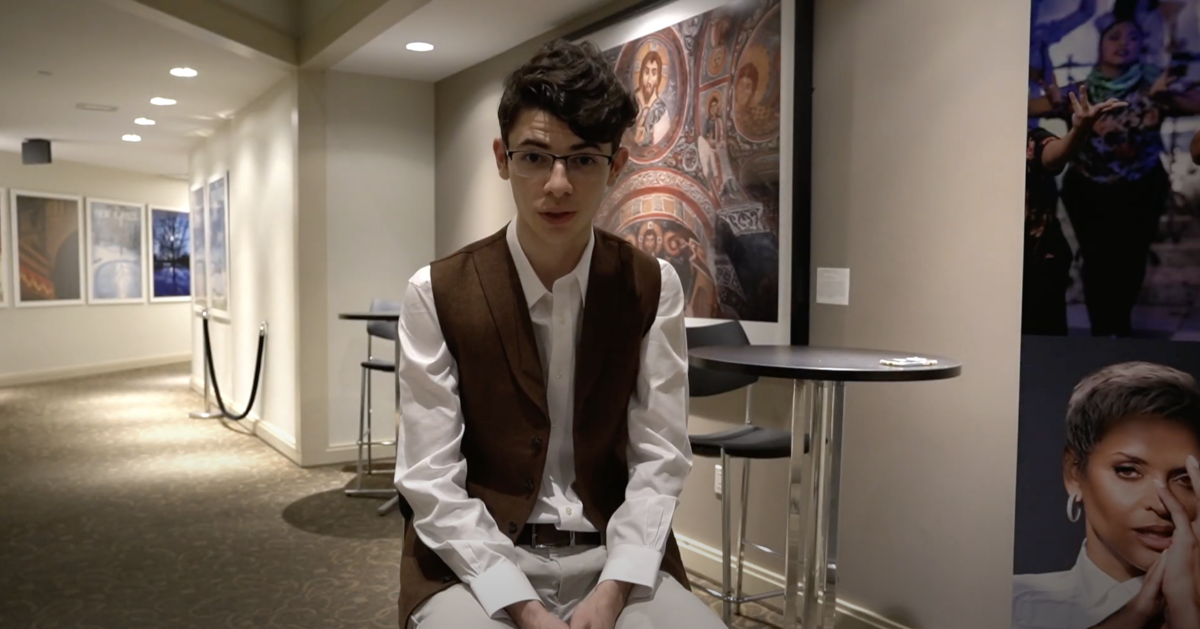
Daniel Mayo ‘25, another Fairfield student closely involved with campus ministry, reflected on Francis’ passing and what the modern papacy has meant for his faith.
“He cared about everyone deeply and loved as Christ instructed us all to do,” Mayo explained about Francis, “He ate with the homeless, sat with the sick, and helped heal the broken hearted. We can all take lessons from that.”
Savard added in his discussion, “What a lot of us love about Francis is that he’s a Jesuit.” He referenced Laudato Si’, the Pope’s second encyclical and papacy–his most notable work exploring modern consumerism and the redefining of global community. Savard reframed the work through the questions that serve as its foundation: “How are we caring for our common home? How are we taking care of it?…A lot of those things really kind of resonate with Jesuits.”
With another conclave—and thus the advent of a new papal reign—imminent, members of the College of Cardinals will make their way to Rome in the coming weeks to determine the Church’s future.
While Francis’ liberal approach to papal rule marked a new era of social change within the institution, prioritizing LGBTQIA+ and other disenfranchised or otherwise oppressed groups among the faithful, its continuation is by no means guaranteed. While Cardinals Matteo Zuppi and Luis Antonio Tagle—notable front-runners whose approaches closely mirror that of the late pope—represent a continuation of the liberal momentum initiated by Francis, their conservative opposition is formidable.
Hungarian Cardinal Peter Erdo, as the New York Times reports, seems to be most likely to lead the conservative wave of conclave voters. Alongside him are candidates like the Archbishop of Kinshasa, Fridolin Ambongo, who served as a close advisor to Francis, but famously opposed the late Pope in his ruling supporting homosexual couples in 2023, per the same New York Times report.
Kevin Camy ‘26, expressed his thoughts on the Church’s future in a statement sent to The Mirror.
“I think the future of the church is bleak and yet hopeful,” Camy explained, referencing the conservative opposition that he’s concerned threatens the momentum of institutional growth ushered in by Francis, “We just have to be hopeful and be enlightened and encouraged by the spirit of Pope Francis so that we can make progress as a church.”
With a conclave on the horizon and the Vatican facing an uncertain future, the significance of Francis is one that cannot be understated. While his legacy may only be fully understood with time, the impact of his reign is one that is already being felt today
With his passing, the religious community now shifts its focus to Rome and the advent of a new, post-Fransiscan papacy.