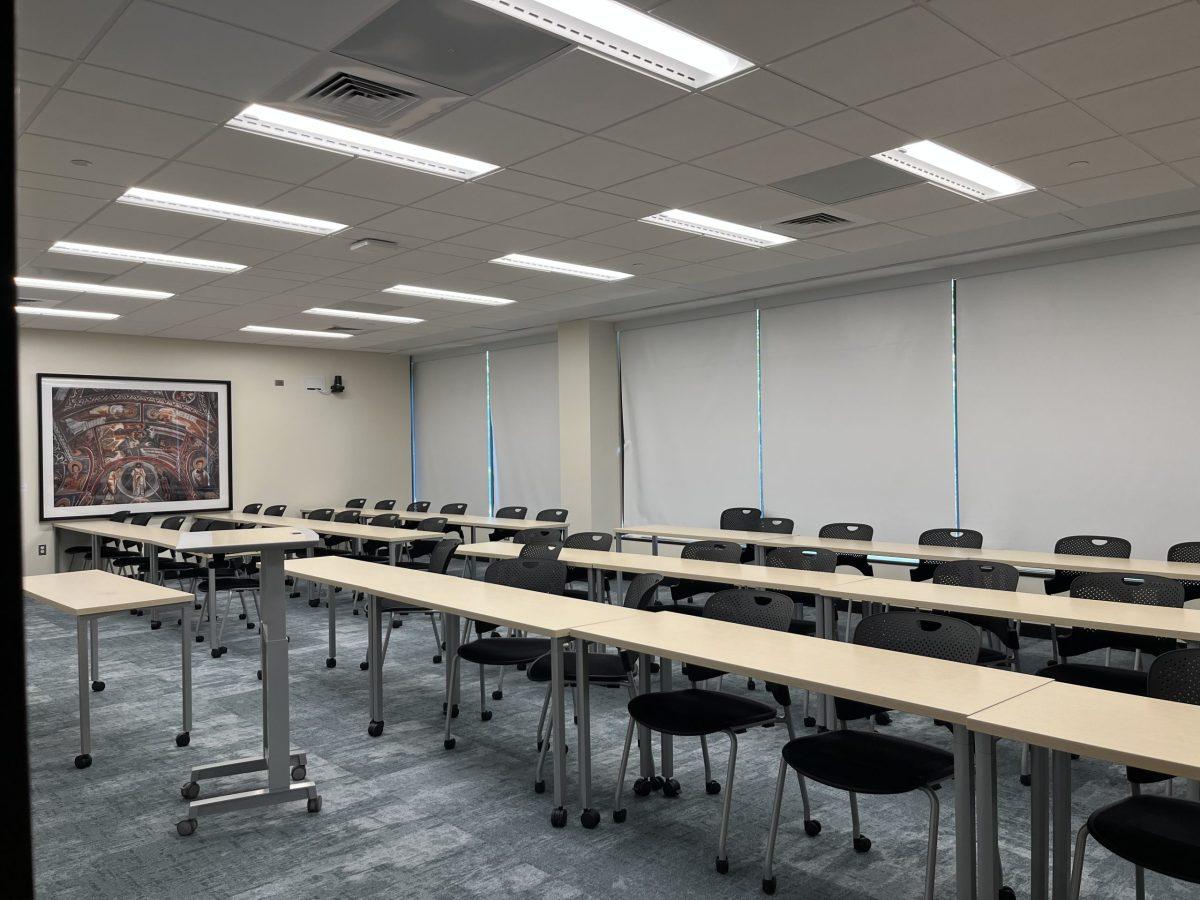
The DiMenna-Nyselius Library looks a little different this year, thanks to a controversial renovation over the summer. While the consensus was against them when they were first announced, as the new school year began, some students’ opinions began to shift.
The upstairs area of the building is no longer solely home to books, but also to classrooms. They shared the renovation information via their website and reassured readers that the other, more consumer-driven spaces in the library would remain open.
The addition of the six classrooms meant the removal of over 25% of the library’s book collection. Additionally, the number of study spaces available to students decreased. These conditions were not previously discussed with the library faculty, but instead, were simply announced.
This renovation generated a lot of uproar, despite it not being the first of its kind.
Elise Borchinski, University Archivist at the library, passionately shared some facts about the building and its history. According to Bochinski, the library underwent two separate renovations before this one, of similar scale.
“[In] 1999, under the leadership of Joan Overfield, who was Director of Library Services at the time, the library underwent a major expansion supported in large part by a generous gift from alumnus Joseph A. DiMenna, Jr., Class of 1980. When it reopened in 2001 as the DiMenna-Nyselius Library, it was more than double its original size, with room for about 450,000 books, seating for 900, group study rooms, two computer labs, a 90-seat multimedia auditorium, a café and lots of inviting study spaces,” Bochinski said.
She also shared that the addition of the various student academic centers happened in 2019, on the main level of the building. While these renovations were well-received, the most recent one had been standing on shaky ground – until now.
Sophomore Charlotte Middleton expressed her love for the building. “I’ve always loved the library. I think any change to it is good. Like, I’ve seen that it looks [a little] nicer, [pretty much],” she said. “It’s my favorite place, [and I] think any renovation they do to it will make it better.”
She continued on, saying that she believed that the more people the library could bring in, the better. Middleton and her friend praised the study rooms as well, saying that they had heavily utilized them in the previous year for their major exams. “We used the study rooms all year; they were really great. So, if they fixed the classrooms, that’s perfect.”
“A key takeaway is that the administration admitted to faculty that the decision-making process was flawed, in that it did not involve those who will use and work in these facilities every day,” said Professor and Faculty Welfare Committee President, Sonya Huber.
She says that because of the way the renovation was labeled as an “emergency”, there was no opportunity for democratic feedback, namely from those working in the library. “I hope that in the future the voices of all affected will be included in such plans as a way to begin to repair the damage.”
Another student, who says she works in the downstairs portion of the building, claims not to have noticed any increase in noise.

This sentiment was also shared by first-year Maddie Lang. However, she did say that the addition of the classrooms was shocking. “I was so shocked when people were saying [they were putting] classrooms in the library. It shows that we don’t have enough space for everyone.”
To further emphasize the students’ love for the library, Bochinski detailed a time in 1965, just three years before the library had first opened, when Fairfield students staged a rebellion to access banned books. “Then, for much of the 1950s and ’60s, the main university library was actually on the main floor of Canisius Hall. [It] held something students called ‘the cage,’ where restricted books were kept — titles that were on the Catholic Index of Forbidden Books, reflecting ideas that the Church viewed as contrary to its teachings.”
Reportedly, the students climbed the cage and took the books out, reshelving them among the culturally accepted volumes. The library’s first major renovation included the removal of the cage, to the students’ delight.
Overall, it seems that the library renovations aren’t as scary as many believed them to be. Their impact on students’ learning and productivity has been minimal, if any. The DiMenna-Nyselius Library is hallowed ground for bookworms and coffee addicts alike, and it seems it’s going to stay that way.