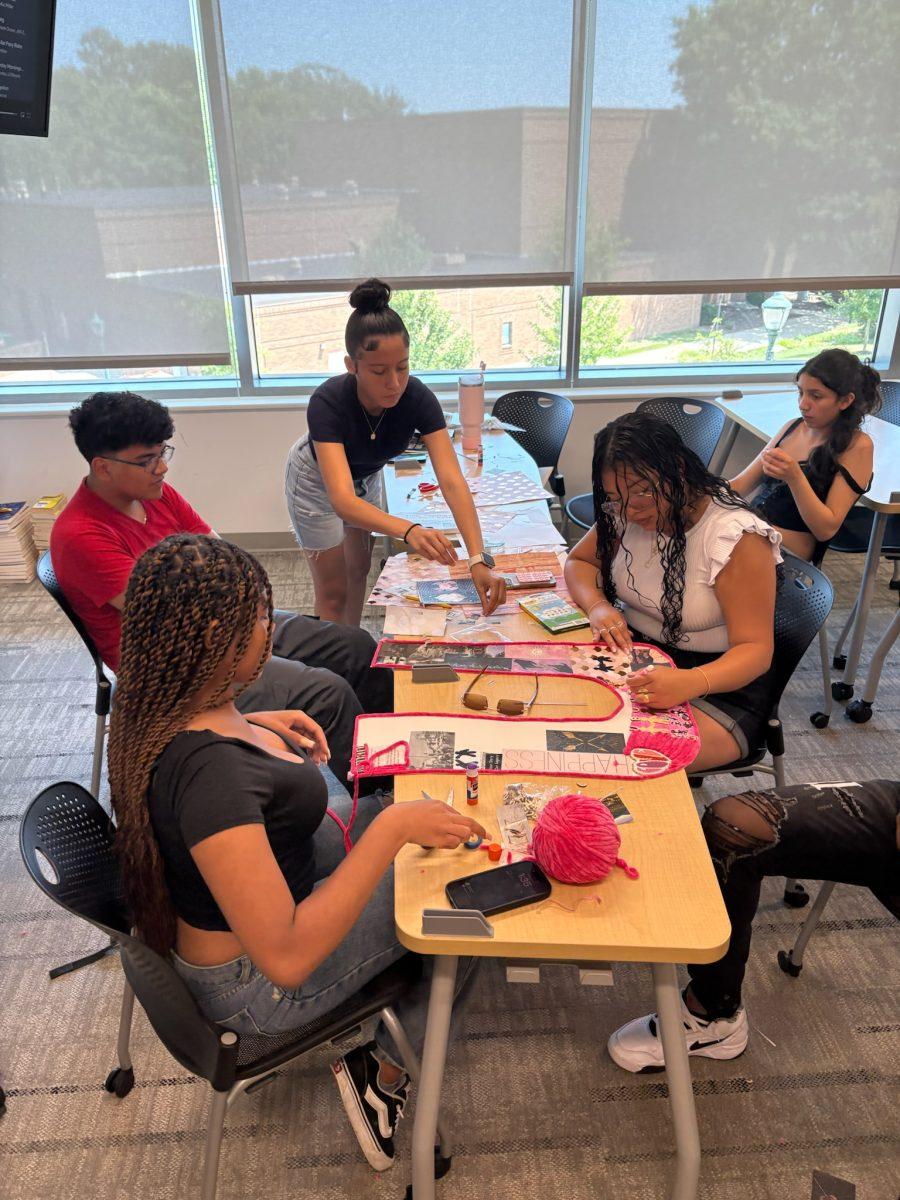
The word “HUMAN” sprawls across the wall of a Dolan School of Business (DSB) classroom, spelled out in oversized letters. The letters, cut delicately from white paper and lined with hot pink yarn, create a stark contrast from the room’s otherwise monochromatic decor. The artwork was created by the students of Ubuntu Academy, a two-week summer program created by the Connecticut Writing Project (CWP).
At Fairfield, CWP is in its 13th year of Young Adult Literacy Camps — a milestone in a continued effort to uplift the voices of newcomers, both refugees and immigrants, to the United States.
The word is built from distinct collages, each letter crafted with textured paper and symbolic details. The artwork reflects the stories of its young creators – layered and vibrant.
The program emphasizes the value of building a classroom community, unifying high schoolers from across the globe as they develop foundational knowledge of the English language. The students breathe new life into the DSB during the summer months, energizing the otherwise empty halls with unbridled enthusiasm for reading and writing.
Bryan Ripley Crandall, Ph. D., is the Director of CWP at Fairfield University and Professor of Literacy in the School of Education and Human Development. His camps were awarded the 2025 Divergent Award for Excellence and extend the mission of the National Writing Project, which is celebrating its 40th anniversary.
Crandall emphasizes the significance of Ubuntu, a South African philosophy that drives each lesson and the program as a whole.
“A human being is a human being because of other human beings,” he explains.
Crandall continues, “It is the philosophy of Ubuntu, which is what started this whole academy for English language learners to realize that human togetherness is the way we get by in this world.”
This year, students connected across cultures, representing countries including Brazil, Afghanistan, Mexico, Peru, Haiti, the Dominican Republic, Ecuador, and Guatemala.
The Fairfield Mirror met with four students enrolled in Ubuntu Academy: a teenage girl from Brazil and three sisters from Afghanistan. Their unique stories encapsulate the larger impact of CWP and reinforce the importance of expanding access to education.
Opening Up and Broadening Horizons
Geovanna, a 17-year-old student raised in Brazil, has returned for a second summer at Ubuntu Academy. She radiates a calm sense of self-assurance, a warm smile filling her face as she reflects upon her experience in the program and considers her next steps.
“I want to go to college, play soccer and find a good job,” she proclaims, her voice steady with conviction.
Geovanna was born in the United States, but moved to Brazil, her parents’ home country, before her first birthday. She returned when she was thirteen and remembers her initial hesitation – unsure how to navigate the language barriers she faced in her new setting.
“I was shy,” Geovanna admitted. “I did not want to speak.”
She credits her teacher at Ubuntu Academy, Mateo Planas, for bridging this gap.
“He spoke Spanish, so we connected,” Geovanna explains, noting how the linguistic similarities between Portuguese and Spanish facilitated their bond. “We spoke a lot and he helped me to fill in the words I did not know in English.”
Her first summer at Ubuntu marked a turning point. As the program progressed, Geovanna’s confidence blossomed. She fostered friendships within the CWP community, her horizons expanding as she connected with peers and teachers who understood her experience and were willing to help.
Within Bridgeport Public Schools, however, Geovanna faced obstacles to success.
“They would speak to me in English, and I could not respond, so I would ask to go to the bathroom to escape,” she reveals. “I would come home crying to my mom, and I wanted to leave.”
Once again, she found another influential mentor: the Founder of Ubuntu Academy, William King MA’15, an English as a second language (ESL) teacher at Central High School in Bridgeport.
“Mr. King encouraged me to do things I wouldn’t have been able to do two years ago. Now, I can not imagine leaving this country.”

A Dream Realized
In the front row of the DSB classroom, three young women sit quietly – their attention rapt, eyes glued to the lesson projected onto the board.
The room is filled with subtle chaos, as high schoolers whisper to one another and stifle giggles as they share secret jokes in many languages across rows.
Still, the trio’s focus is unwavering. Their pens are a blur — a symptom of their furious note-taking and a sign of their shared desire to soak up every drop of knowledge from CWP teachers, who this year include Master of Arts in Education candidates Emmi Lawson, Shane Carley, Eva Criscuolo and Max Limric ‘25.
Mahjoobah, the middle sister, provides a glimpse into their recent past. They left Afghanistan just eight months ago, embarking on a journey to the United States with renewed hope for a future of independence.
“In my country, there is no studying for girls,” she describes. “The Taliban has taken control, so I haven’t been able to study for four years.”
Mahjoobah’s insights reflect not only a deep love of learning, but also the profound sense of empowerment that comes from accessing education freely—an opportunity that many girls from Afghanistan have long been denied.
“It is so helpful to learn English and to be able to read and write,” she states, her sisters nodding in agreement. “This is what all Afghan girls dream of.”
The Boundless Power of Language
The spirit of Ubuntu Academy and CWP reflects the Jesuit mission. Crandall notes that, although Fairfield University is the only Jesuit institution associated with the National Writing Project, Ignatian ideals are embedded in its teachings and the rich humanity of the students it serves.
The program culminates in a final publication. Titled “POW! The Power of Words”, the students’ work is compiled into an anthology, a tangible product of their growth in finding their voices and discovering the boundless power of language.
In an attempt to capture this power, Crandall concludes, “Writing is empowerment and writing is healing and writing is healthy and writing is the way we find ourselves understanding who we are as human beings.”