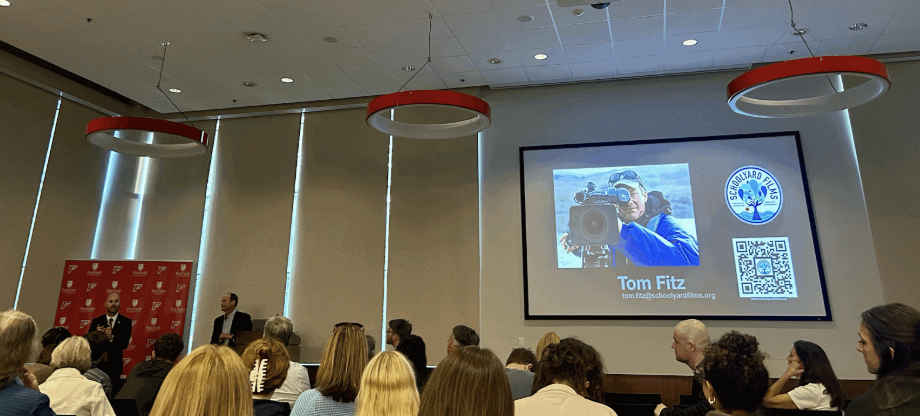
Some filmmakers work in studios, adjusting lights and communicating with actors. Tom Fitz, on the other hand, works in the freezing Arctic, the sticky Amazon and many unpredictable locations that test his limits and creative abilities.
For over 30 years, American cameraman, producer and director Tom Fitz has been exploring all the ways he can use his creativity and passion for good. Last Wednesday, Fairfield had the opportunity to hold a seminar hosted by Fitz as he explained his exciting and adventurous lifestyle as a cameraman.
This seminar was a part of a series hosted by the Center for Climate, Coastal and Marine Studies. This center launched in Aug. 2024 and aims to support “Fairfield University’s commitment to addressing pressing environmental challenges for the well-being of society and our planet.” Supported by 30 faculty members, the new Center for Climate, Coastal and Marine Studies is designed to encourage research from students interested in the field. They host a series of seminars throughout the semester, with Tom Fitz being the first one.
Fitz started his career as a freelance cinematographer, working for National Geographic, BBC, PBS, Discovery and more. Through his work, Fitz has captured incredible footage of the natural world. He is the recipient of six Emmy Awards and two British Academy of Film and Television Arts (BAFTA) Awards. Unlike many camermen, Fitz has worked all seven continents and five oceans, where he specializes in underwater camera work. He explained, “I never get asked to go to Africa to film Lions or Hyenas, but I’ve always wanted to. My niche has been wonderful marine animals.”
He has always been fascinated by animal behavior. In college, Fitz had a communication project between humans and dolphins. This is where his love for film really took off. From there, he branched out into larger mammals.
One of Fitz’s most memorable locations to film is the Arctic. In 2011, Fitz and his team spent a month in Antarctica filming for the BBC show “Frozen Planet.” Narrated by David Attenborough, this show showcasing the harsh conditions of the polar regions and follows the lives of animals living there.
Fitz described his time in the Arctic as difficult but rewarding. He explained the unique foods they had to eat, including boiled seal. He joked and said, “If anyone wants to lose some weight, go up there for a month.”
Having been to all seven continents, Fitz has a lot of experience with diverse culture, extreme climates and new atmospheres. He feels fondly about his time in the Arctic and other continents. He said, “I love working up there and I love working with new people and new cultures. I want to learn about their culture and the foods they eat.”
In 2008, Fitz had a bit of a career change. He began to really recognize the horrible conditions that the earth was experiencing, due to climate change. He started a production company, “Schoolyard Films,” with a hope to educate the youth about the importance of environmentalism.
Fitz joked that, “When we started I had an audience of three people, my three children.”
Now, “Schoolyard Films” has produced 26 films and has reached over one million students. They provide K-12 schools with free programming of their productions, with the hope to educate and inspire the next generation.
In a world filled with climate change and harm, Fitz remains as optimist, always trying to find the good in the world. He has seen many awful things happening to the planet, but he explained that he makes an effort to focus on the positive ones.
In 2016, Fitz had a near-death experience in Panama, while filming for BBC’s “Our Planet II.” On one filming day, Fitz was trying to get a good angle of sloths. He said, “I was looking up and not looking at what was around my feet, then I felt the most intense pain. I was jabbed by a stingray barb that went through my ankle.”
Fitz was stung by the same type of stingray that killed Steve Iriwn in 2006. Five surgeries and a year of recovery later, he returned to Panama to get one final shot. Despite the near-death experience, Fitz was dedicated to his craft. He described Panama as spectacular and said the positive outweighed the negative.
With projects taking him all over the world, Tom Fitz has seen it all. From Narwhals in the Icy Arctic to Sloths in the tropical forests of Panama, Fitz captures the world’s beauty for what it is.
The next seminar for the Center for Climate, Coastal and Marine Studies will take place Wednesday Oct. 1 at 1:00 p.m. in Library 101 auditorium. Dr. Shannon Gerry and Dilani Perera will be the speakers for this event, highlighting the importance of the program.