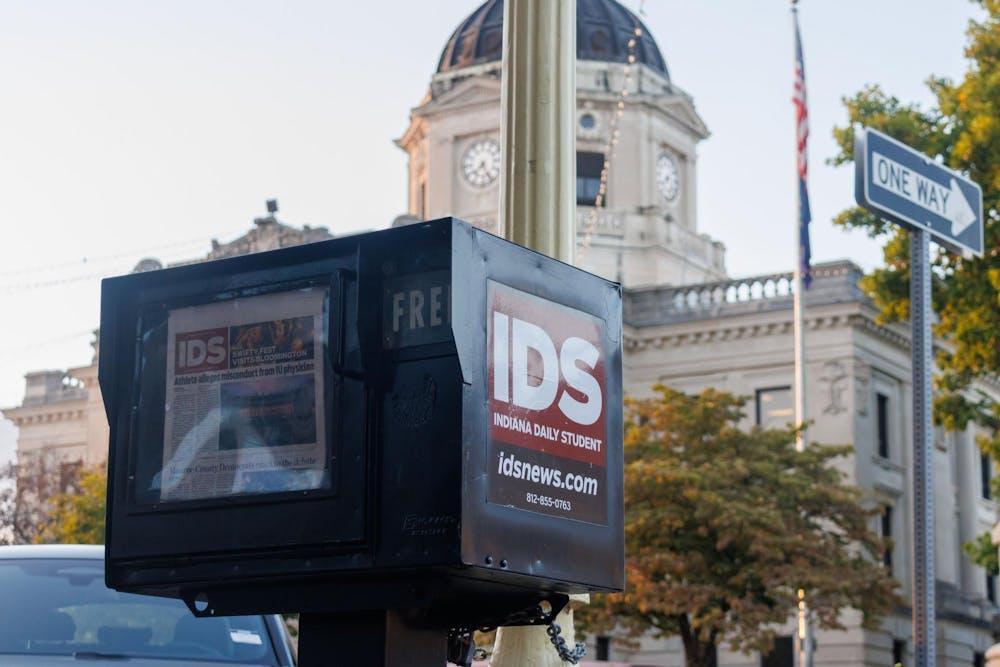
The Indiana Daily Student, the independent, student-run newspaper of Indiana University Bloomington, will, as of Oct. 16, no longer appear in print on campus. The director of the Media School, Jim Rodenbush, who also advised the paper, was fired. All of this was, according to reports by The New York Times and the editors of the Indiana Daily Student itself, an effort to censor the paper.
This is not the paper’s first brush with authority. They came under fire in 2024 after Lieutenant Governor Micah Beckwith incorrectly asserted they had made disparaging statements about President Trump, which were actually quotes by members of President Trump’s own administration, as per WTHR.
This current censorship is merely the culmination of a long conflict.
The students of Indiana are not the first to have their press censored and they will hardly be the last. Papers around the country, including but in no way limited to Washington Square News at NYU, the Columbia Daily Spectator, the Harvard Crimson and the Tufts Daily, have all weathered attacks from school administrations whose job is, ostensibly, to protect and promote student journalism as an essential part of their students’ education.
More chilling, even, have been the personal attacks. Editors and journalists for papers have been hounded by the administration and law enforcement, among them, famously, Tufts student Rümeysa Öztürk, whose detention I covered in our April 2, 2025, issue.
This is, at its heart, anti-American behavior.
Inscribed in the base of the Statue of Liberty is a poem by Emma Lazarus called “The New Colossus,” which reads “Give me your tired, your poor/Your huddled masses yearning to breathe free.”
The singular greatness of this country is that, unlike many other developed democracies in the world, we protect freedom of speech in our most important, defining document. It is why so many come here, where they can breathe free.
As universities deal with the ire of President Trump’s administration, it is a tragedy that student journalists have been some of the first victims of their capitulations. Student journalism, and indeed free and protected journalism itself, is part of what makes the United States of America the country that it is. It is, among all the rest, the First Amendment and what it protects that has brought so many people to American shores. It is our first and highest ideal, and one of the greatest gifts the Founding Fathers left us.
Even beyond their service to democracy and the democratic tradition, the work student journalists do is important, which is one of the reasons, among many, that it is being censored. Student journalists uncover the lies and corruption that riddle university administrations. They highlight ongoing racial and political inequities on campuses. They give a voice to students everywhere.
More personally, student journalists are a community, no different than student athletes or countless clubs. Journalism is not just a protector of democracy to us, but a passion, a privilege and an honor. We dedicate ourselves to this because it means something to us, and because we believe in it, not just when it is easy, but when it is difficult.
The Mirror has, so far, escaped the fates that have befallen other papers. Yet, watching other papers suffer the fate of the Indiana Daily Student, it is not hard to be concerned. What they do is what we do, in offices that look a lot like ours and with papers that, while formatted and colored differently, probably feel and read quite a bit like ours too. These are students who have now lost an essential piece of their resumes and who will no longer be able to approach employers with a portfolio showing that they have put words into print. These are students who have had their First Amendment rights stifled by the administrations that are supposed to be protecting them. It is a betrayal and a dishonor.
Student journalists, however, have the moral high ground. No school looks good when it attacks its own students, and this is something that must be harnessed. Even the most embattled newspapers must continue to publish and print, however they can, and with whatever funding they can obtain. We owe it to each other, and more importantly, we owe it to our friends and peers and to our country.