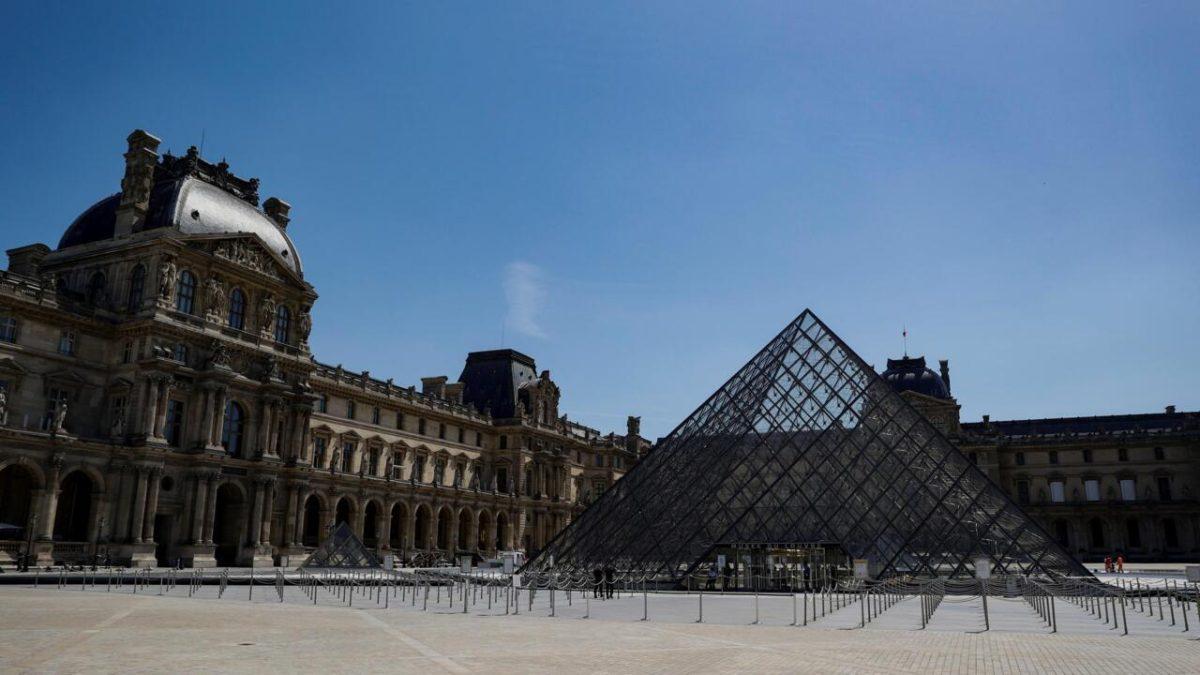
A picture taken on June 23, 2020 shows the Louvre pyramid by Chinese architect Ieoh Ming Pei, the entrance to the Louvre Museum in Paris. - The Louvre museum will reopen its doors on July 6, 2020, after months of closure due to lockdown measures linked to the COVID-19 pandemic, caused by the novel coronavirus. The coronavirus crisis has already caused "more than 40 million euros in losses" at the Louvre, announced its president and director Jean-Luc Martinez, who advocates a revival through "cultural democratization" and is preparing a "transformation plan" for the upcoming Olympic Games in 2024. (Photo by THOMAS SAMSON / AFP) / RESTRICTED TO EDITORIAL USE - MANDATORY MENTION OF THE ARTIST UPON PUBLICATION - TO ILLUSTRATE THE EVENT AS SPECIFIED IN THE CAPTION
On October 19, 2025, the Louvre was robbed, and it’s one of the funniest things to come out of 2025.
The thieves stole eight pieces of the French Crown Jewels- a historic set of crowns, diadems and jewels- valued at around $102 million, according to The Washington Times. The entire robbery took less than eight minutes in total – almost as quick as it took social media users to memeify the whole thing.
This past week, videos on TikTok have been blowing up of people’s “Louvre robber” Halloween costumes. The get-ups feature bright yellow construction worker uniforms, a nod to the fact that the thieves entered the museum disguised as construction workers. Users are also adorned with crown and jewel accessories, poking fun at the robbery. These costumes, along with numerous other satirical posts spread across social platforms, show how a high-profile art robbery has become an utterly hilarious meme.
Let’s make one thing clear: I do not support the robbery of world-renowned museums. Please, don’t do that.
However, I think Gen Z’s sensationalization of the heist reveals just how unserious we tend to make global events. The internet has turned everything, even art theft, into entertainment. Satire has become our default, helping us process chaotic events, and I don’t think that’s necessarily a bad thing.
Posts on social media, even though they may seem frivolous on the surface, are truly forms of social commentary. In the case of the Louvre robbery, I feel as though people are suggesting that the whole issue seems “silly” because it wasn’t taken as seriously as it should have been.
The heist exposed the Louvre’s security failures, including outdated surveillance systems, expired camera permits and slow emergency response protocols. These are real issues that need to be addressed in a place that houses so many objects of historical and monetary value. So, making lighthearted, humorous posts online adds to the sentiment that more action needs to be taken if higher institutions want to be viewed in a serious light.
I also think a lot of the memes simply stem from users’ confusion over the whole spectacle. Wondering how such a high-class establishment like the Louvre was robbed of such expensive and valuable pieces in broad daylight is a valid thought, and social media has become a place to seek answers.
Creating written posts, video content or memes has become one of the most common methods of communication among the younger generation. It’s our new norm, so we’re going to use it to express our thoughts and feelings towards world events.
Keeping things lighthearted makes information more digestible, sparking new conversations every day. Most social media users are not trying to “glamorize” this crime, even if their irony could read as such. They are simply attempting to get involved in the discourse.
I think it’s super cool how so many more young people are expressing their opinions on global issues, whether political, cultural or environmental. So, if dressing up as a Louvre robber for Halloween was your idea of making a statement, I’m glad you went for it.