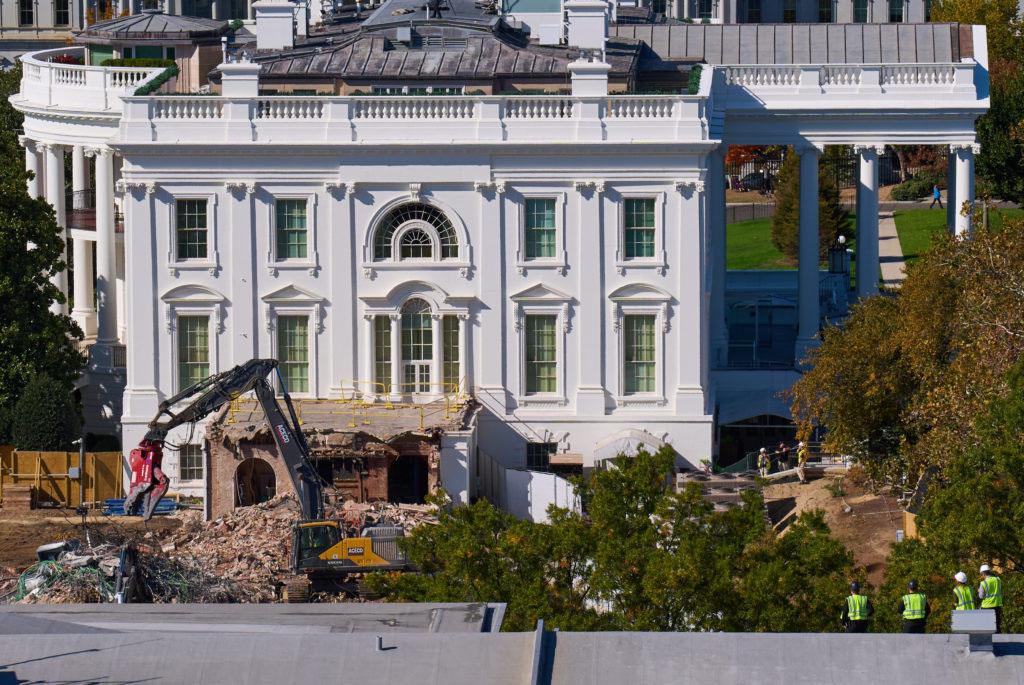
Construction workers, bottom right, atop the U.S. Treasury, watch as work continues on a largely demolished part of the East Wing of the White House, Thursday, Oct. 23, 2025, in Washington, before construction of a new ballroom. (AP Photo/Jacquelyn Martin)
There’s a lot to be said about the physicality of the American conscience. We think of America in terms of the Statue of Liberty, the Lincoln Memorial and the Empire State Building. We are obsessed with our flag and put it just about everywhere. We hail Fenway Park and Wrigley Field as classic symbols of a great American pastime. These are, mind you, nothing more than two baseball stadiums, iconic though they may be.
This way of thinking has some reason to it. Our buildings and our symbols outlast us. The immigrant men who straddled steel girders over 100 feet above the East River may be largely forgotten, but the Brooklyn Bridge isn’t. It has become a symbol far greater than anyone who designed or built it. Not only a symbol of American ingenuity, but a testament to the grit of those who came to our shores then and continue to arrive now.
If the presidency has a symbol, it is undeniably the White House. It has become so inextricably linked to the office that it now serves as its metonym. Though only a building, it has become something far grander. It is a living symbol and history of our representative government, laden with all the ideals and burdens of democracy.
Consider its size. Including the recently destroyed East Wing, as well as the more famous West Wing, the modern White House is only 55,000 square feet. That may sound massive, but Buckingham Palace is 830,000 square feet. When the White House was built, many observers doubtless compared it to the colossal Palace of Versailles, which stretches over 721,000 square feet on about 2000 acres, and found it lacking. That’s the point, though. The White House may be a stately home, but it is, ultimately, still a home in which children have grown up and countless pets have roamed. It just happens to be home to a very particular family with some very particular duties.
In a democratic country, we do not have palaces. Our elected officials may live dignified lives, but we do not expect nor desire them to live ostentatious ones. In the splendor of the modern United States, we sometimes forget that our beginnings were far humbler. We were a country of farmers, merchants, shipbuilders, fishermen and printers. We built our greatest home to represent that.
What happens, then, when a long, dignified and symbolic history meets a man with no respect for it and an obsession with arbitrary power?
In the midst of what is now the longest government shutdown in American history, President Trump ordered the demolition of the historic East Wing and the construction of a new White House State Ballroom, which will amount to a 90,000-square-foot expansion and seat, according to the administration, 650 people, but may very well seat 900, according to NBC.
If the White House is a symbol of American democracy, then President Trump has taken a sledgehammer to it.
Since 1800, every president living in the White House has been satisfied with the 200-person capacity of the Executive Mansion’s East Room, or, when the need called for it, the occasional outdoor tent. For two centuries, the White House has still managed to be the center of society in Washington and for the government in general. How many parties have been held there? How many foreign guests have been entertained there?
The idea of a 90,000-square-foot ballroom, described by the administration as an “ornately designed and carefully crafted space,” flies in the face of everything the White House represents. It is an ostentatious, gaudy and immense stain on the building, more similar to Louis XIV’s vision of the Palace of Versailles than James Hogan’s modest presidential home. It is the vision of the man who built Trump Tower.
As a physical symbol, the destruction and replacement of the East Wing with this monstrosity is representative of President Trump’s entire administration. His style has often been deemed (by such authorities as Politico and The Guardian) “move fast and break things,” and that seems to fit whether he is dealing with courts or a hallowed symbol of the American state. Fitting, too, that, according to the BBC, Amazon, Lockheed Martin, Palantir and Stephen A. Schwarzman, the CEO of Blackstone, are bankrolling the renovation, among many other mega corporations and billionaires. When the administration has been bought and paid for by the wealthy, why not the White House itself? How else should the public interpret the funding of this building if not as a ticket for special access to the presidency? For a man who so often claims he is the furthest thing from a king, President Trump sure seems to love all the trappings of kingship. The White House renovation may be just one more offense, but in a country so defined by its physical symbols, it is an offense that stings and will last long after President Trump is gone.