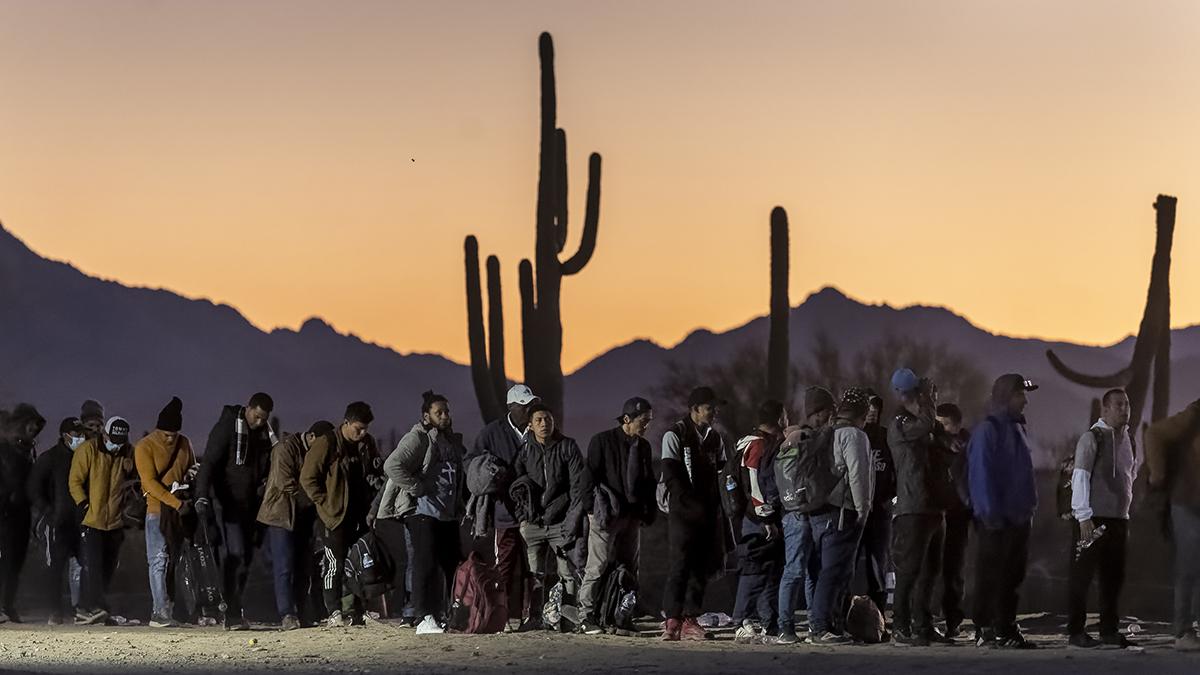
LUKEVILLE, ARIZONA - DECEMBER 07: Immigrants line up at a remote U.S. Border Patrol processing center after crossing the U.S.-Mexico border on December 07, 2023 in Lukeville, Arizona. A surge of immigrants illegally passing through openings cut by smugglers into the border wall has overwhelmed U.S. immigration authorities, causing them to shut down several international ports of entry so that officers can help process the new arrivals. (Photo by John Moore/Getty Images)
The hotbed of immigration headlines in the first six months of the new presidency in 2025, led researchers and students at the Digital Immigration Lab (DIL) to voice their moments of satisfaction and inspiration in refugee work. This article is based on students’ and researchers’ first-hand experience of working with refugee resettlement programs in Texas. This experience had a profound impact that led to the formation of DIL, and left the team wondering: Why is working with refugees inspiring? What are our responsibilities as civil participants at this moment? What can we do? And why should we do it?
Introduction
The Trump administration’s first 100 days has seen an aggressive immigration agenda. With their potentially unrealistic aim to deport 1 million immigrants annually, they have deported over 158,000 in 2025 (DHS). Almost 160,000 “illegal aliens” have been arrested. These executive actions have not only impacted the federal agencies but even those working to help refugees within the US. The Trump administration’s federal funding freeze on refugee resettlement agencies, in particular, has had drastic consequences. Agencies were told they would not receive any further federal funding and were forced to lay off staff in order to continue helping their existing clients. Potential new clients have been left without resources or avenues for aid, as per ProPublica.
While non-profit organizations catering to refugee aid continue to downsize, ICE has grown in both enforcement and detention capacities, with the New York Times reporting Trump planning on allocating 45 billion for ICE developments, as per ProPublica. This aggressive anti-immigration agenda has led to unprecedented detentions, arrests and deportations by ICE, but most of all it has been performing as a covert means of fearmongering in the immigrant communities. Numerous incidents of immigrant families picked up at their court hearings, at school and work have surfaced as have the elaborate arrangements to detain immigrants in facilities in El Salvador and the Everglades. The weaponization of immigration has had expansive consequences.
Behind the fearmongering and scapegoating of immigrant communities lies a very different story. In spite of the U.S. being a nation of immigrants where every family has its own stories of immigration, the current legalities, processes and means of immigration remain a mystery to most people. Eager to learn about the world of immigration, our team spent the duration of the 2023 spring break with an international refugee relief organization in Texas. When our team of two faculty and six students gathered through our shared interest in humanitarian work, we had no idea that we were about to share an experience that would change the way we viewed our commitment and responsibility towards social action forever.
The trip was facilitated by Fairfield University’s Center for Social Impact, which organizes an annual spring break trip for participating students and faculty to have a hands-on experience of learning about a major humanitarian organization in Texas. With a major commitment towards social justice, this trip furthers Fairfield’s commitment towards Jesuit values and social work.
In Spring 2023, the refugee relief program’s office was inundated with migrants from Cuba, a combined result of Covid-19 and Russia’s war with Ukraine. Cuban migrants, as a part of the CHNV parole program, undertook journeys through six countries on a combination of foot and caravans to find refuge in the U.S. This migration demographic was so large that Cuban economist and demographer Juan Carlos Albizu-Campo calls it “demographic depletion”. It was sobering to see the effects of globalization and war happening in front of our eyes. The team at the office was relentlessly committed to refugee resettlement. Their efforts were very sincere and equally understaffed and overworked. To them, every bit of help was invaluable.
As a part of the program, the team learned about the numerous departments at the office. However, we primarily worked with refugee children in their spring break camps. These were kids of K-12 age who were in varying stages of school integration and who saw us college students and faculty as fun, welcome relief. We learned their names, participated in their lessons and watched movies with them, all while internally igniting our urge to make a difference. It felt transformative to be in those rooms and halls filled with those starry-eyed kids! After lunch, we squeezed into cramped offices filled with ancient filing cabinets to create a sense of order. We alphabetically filed thousands of files in an effort to “make a difference.”
The experience at the program instilled a zeal in us to help the children and the families who had been so drastically uprooted from their own countries because of pogroms, violence, hunger and difficulty. We debated on how we could help most: Would digitizing files help with the huge upsurge of refugees at our doors? Will alphabetizing manual files in dusty rooms help? Will sorting through documentation and aid services help them gain a footing in their new country? Or, would bonding with refugee kids help assuage the trauma of migration carried by migrants in their physical bodies? What will help heal this unresolvable wound of global instability, of which migration and “illegal migrants” are just a syndrome? The transformative nature of our refugee work drives this article. There is a lot to be done, for a good cause and for good people. Hence, we ask, why is this work important, what work is effective work and what will help?
What Is Our Responsibility?
One of our most impactful experiences at the spring break camp was a visit to the homeless shelter. The air at the shelter hung heavy with desperation–a quiet, suffocating weight that clung to the ragged clothes and shaky hands. We had come to gather food for refugee children whose families couldn’t afford the time and money for a meal. A familiar hopelessness animated their plight–fleeing war or ruin only to land here, where survival meant relying on strangers’ mercy. The despair we saw in the shelter was a raw echo of the refugees’ own internal struggles: a shared unraveling of dreams, where each day gnawed at both body and soul, binding them in a silent, universal yearning for something better.
What should we, as ordinary people with ordinary occupations, do in order to counter this circuit of fear-mongering, xenophobia and exclusivism? As a group of young students and faculty, we were surprised by the amount of effort that went into rehabilitating refugees and asylum seekers. The children we worked with ranged between four to 18 years of age, and a lot of them had to go through grueling experiences to migrate from their homes. A lot of them faced threats that they could not articulate. When we digitized records of immigrants seeking asylum from Cuba to the U.S., we noticed significant numbers of single mothers migrating with children who were as young as a few months, maybe even born on the treacherous journey. As a group of educated intellectuals invested in contributing to the community, we could not stay there and do nothing.
This experience led us to decide to be conscious consumers of the rhetoric floating around us. Let us not sink into misinformation. That is where the real work lies. In this day, when most refugee relief organizations are under fire, working in NGOs might not be a realistic solution for all of us, nor a possibility. But we can persevere against this hate. Let us read, research and find real details and evidence about policies that implicate us. Engaging with our communities and learning about real, human stories is the most important part of understanding and being informed. Numbers only get us so far, but it is the personal narrative that means the most, especially in the context of a complex, difficult, multi-faceted human experience like immigration.
It is only “us” we have been waiting for.
*Usage of terminology such as immigrants and refugees are contextual and general. It is not aiming to provide any particular definition of any or either of these terms.
Photo courtesy of NBC.
Writers of this piece are a group of students and faculty who are interested in humanitarian work. This specific article emerges from Spring Break Trips organized by The Center for Social Impact at Fairfield University, CT. Currently the Digital Immigration Lab (DIL) is a multi-institution project with participating students and faculty from Fairfield University, CT and Washington University in St. Louis (WashU), MO.