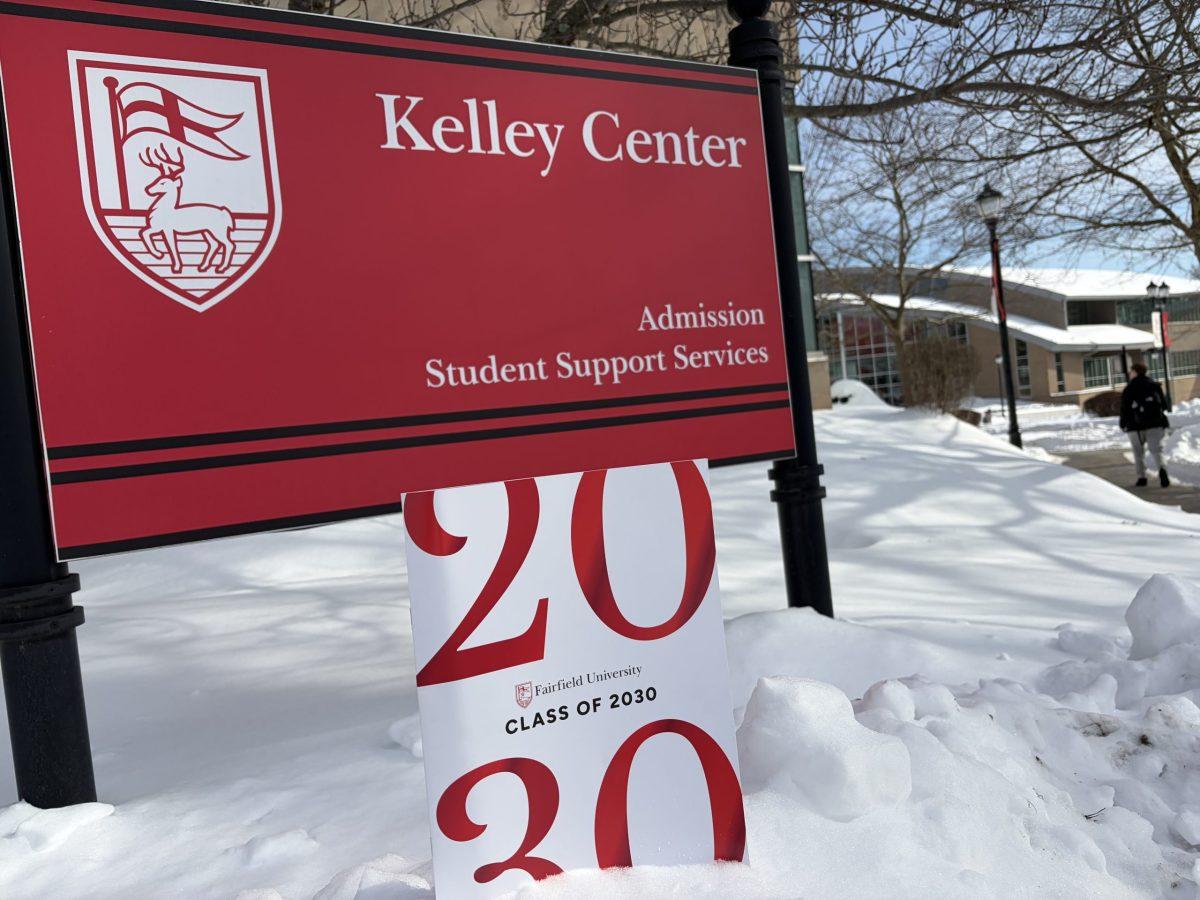
Fairfield University’s Early Action and Early Decision admission cycles have become increasingly competitive in recent years, as application numbers continue to rise and acceptance rates steadily decline. While university officials point to Fairfield’s growing reputation and strong enrollment yield as key reasons for this trend, some current students have begun raising concerns about how increased enrollment is affecting daily campus life.
“I have been hearing that it’s becoming more students’ dream school,” said sophomore Milly Olch, Tour Guide and Shadow a Stag Host.
For the Class of 2029, Fairfield received 15,040 Early Action and Early Decision applications representing 2,376 high schools across 47 states and numerous countries. Of those applicants, 4,290 students were admitted, resulting in a 28% acceptance rate. Academic credentials among admitted students remained strong, with an average weighted GPA of 3.95 and a middle 50% SAT range of 1320 to 1420. Fifty-nine percent of admitted students are from Jesuit and Cristo Rey high schools.
Selectivity increased further for the Class of 2030. The university received 15,997 Early Action applications from 2,588 high schools spanning 47 states and 63 countries. From the pool, 3,475 students were admitted, lowering the acceptance rate to 22%. Academic metrics remained consistent with an average weighted GPA of 3.95 and a slightly higher middle 50% SAT range of 1320-1430. Test-optional applicants accounted for 58%.
“I’m glad I applied to this school as the acceptance rate declining, my degree will be worth more as the school improves,” said freshman Liam Swords, who applied Early Decision.
Regina Norum, an incoming member of the Class of 2030, shares a similar perspective.
“I think that Fairfield is a little more competitive now,” Norum, a high school student from New York said. “I feel that the lowering acceptance rate is a good investment because it really shows what specific things Fairfield is looking at in students.”
Corry Unis, Vice President, Strategic Enrollment Management, emphasized that the decline in acceptance rates is largely driven by the increased number of applicants alongside a growing yield rate, rather than stricter evaluation standards. As Fairfield continues to emerge as a first-choice school for many students, fewer offers of admission are required to build each incoming class.
Academic rigor remains a central component of the admission process. Strength of schedule and grades are among the most heavily weighted factors, along with demonstrated interest in Fairfield. Essays and recommendation letters also play a key role, providing insight into applicants’ characteristics, values, and potential contributions to campus life. Admissions officials noted that these materials help the Enrollment Management team shape a balanced and engaged student community each year.
Fairfield’s Jesuit identity is another defining element in its admissions approach. Unis stressed that the university’s Jesuit tradition and commitment to Ignatian teachings are highlighted during recruitment efforts. The admissions team views Fairfield’s Catholic mission not as an add-on, but as a core part of the university’s academic and student experience, influencing learning both inside and outside the classroom.

“All applicants to Fairfield are reviewed holistically,” said Unis, noting that “every application goes through the same process,” regardless of whether students apply Early Action, Early Decision, or Regular Decision.
While Fairfield’s rising selectivity has strengthened its academic profile, some current students have expressed concerns about the impact of increasing class sizes on campus infrastructure. Complaints about long lines at the Tully, crowded common spaces, and limited availability of study areas have become more common in recent years. This past summer’s recent decision to convert portions of the library into classroom space has further fueled conversations about whether campus resources are being stretched too thin.
These concerns are underscored by the rapid decline in acceptance rates over the past several years. Current sophomores were admitted at an acceptance rate of 33%, a figure that has since dropped to 28% for the Class of 2030. For some students, the trend raises questions about whether enrollment growth is outpacing the university’s ability to expand facilities and services at the same rate.
Admissions officials continue to encourage students to visit campus as part of the application process, emphasizing that a campus visit remains one of the best ways for students and families to understand Fairfield’s academic environment and community culture. While senior year grades are still important, admissions officers noted that they are not factored into the majority of early admissions decisions.
As Fairfield University continues to attract a growing and increasingly competitive applicant pool, the university faces the dual challenge of maintaining academic excellence while addressing student concerns about capacity and campus experience. With application numbers showing no signs of slowing, conversations surrounding enrollment, infrastructure, and student life are likely to remain central to campus discourse in the years ahead.
“I think the lower acceptance rate is a good thing,” said Olch. “But I hope that students are applying Early Decision because it’s a dream school not because of the acceptance rate.”
Editors note: Julian Nazario did not edit this article due to a conflict of interest related to his role as a Senior Fellow in the Office of Undergraduate Admissions.