














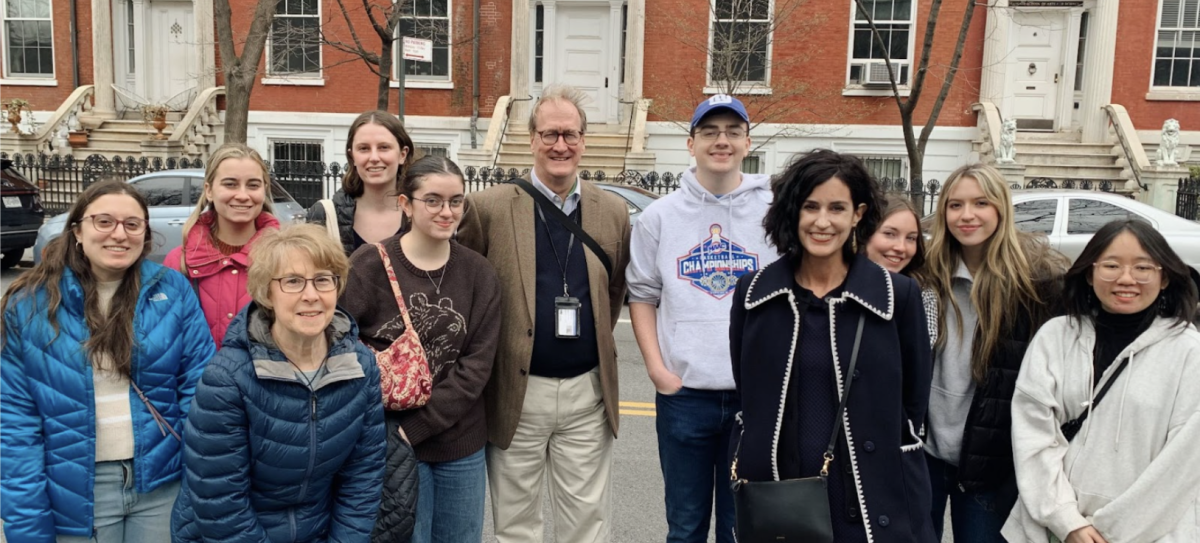
Stepping into the main concourse at Grand Central, I felt as though I had entered the pages of Edith Wharton’s “The House of Mirth.” The walking tour of Wharton’s New York was organized by Dr. Emily Orlando and led by Carl Raymond. I had the opportunity to see the city through Wharton’s eyes – the grand avenues, detailed architecture, and the social spaces that shaped her life and her fiction.
Wharton’s New York extended mainly from Third to Sixth Avenue, with the center around what is now New York University. It was fascinating to learn that until 1898, New York referred solely to the Manhattan borough, emphasizing just how small Wharton’s social circle truly was.
One of the most surprising connections was that, at just four years old, Wharton’s parents rented out their New York home and took her to Europe for six years. Experiencing France, Italy, Germany, and Spain at such a young age deeply shaped her worldview and psyche. Raymond stated that in Wharton’s social world, “wealth was defined by conformity,” with every building and person expected to fit into the same mold – a sentiment she challenged throughout her life and literature.
One of the most striking stops on the tour was Wharton’s childhood home at 14 West 23rd Street, where she first learned to read in her father’s library. Today, somewhat ironically, the site is home to a Starbucks. Our guide, Raymond, shared an interesting connection: Wharton was related to Herman Melville, the author of “Moby-Dick.” The Starbucks name, of course, was inspired by the character from Melville’s novel, creating a fitting literary link.
As we walked through Gramercy Park, I imagined Wharton’s parents living in a home there, surrounded by brownstone buildings. Wharton’s distaste for New York’s brownstones was particularly interesting. According to Raymond, she despised their rigid, dull style – a sentiment that later influenced her book, “The Decoration of Houses,” where she argued for a more elegant, flowing design.
The tour also introduced us to the Tenderloin district, a neighborhood once infamous for its entertainment venues, saloons, and gambling halls. It marked a stark contrast to the affluent areas of Fifth Avenue and Madison Avenue, where the city’s elite resided. The Fifth Avenue Hotel, once a glamorous gathering place for celebrities and prominent figures, offered elegant dining and entertainment. However, just on the other side of the avenue, the area shifted dramatically. There, working-class families and poorer residents once lived, highlighting the sharp class divide that Wharton often captures in her work.
We visited significant landmarks from Wharton’s life and fiction. Trinity Church, where she married her husband Teddy, and Calvary Church, where she attended services as a child, were both stops on the tour. Junior Nicole Berger states, “I loved seeing Trinity Church since I wrote about it in my research presentation – it was amazing to experience it in person.” Grace Church, with its Gothic architecture, was where the wedding scene in “The Age of Innocence” took place, blending Wharton’s actual surroundings with her fictional world.
We strolled through Madison Square, where Wharton began her Memoir, “A Backward Glance,” recalling childhood walks with her father. Passing the former site of the Academy of Music, where Wharton once watched opera performances, I was struck by the continuity of history – the venue still stands today as a cinema.
Finally, we learned about Beatrix Farrand, Wharton’s niece and a renowned landscape architect. Farrand’s contributions to The Mount, Wharton’s home in Massachusetts, included detailed drawings of an extensive kitchen garden, further allowing me to see the physical connection between Wharton and her friends.
Walking the streets of Edith Wharton’s New York was more than a tour – it was a window into her imagination. Seeing the places that shaped her stories made her fiction feel more tangible and deeply human.