








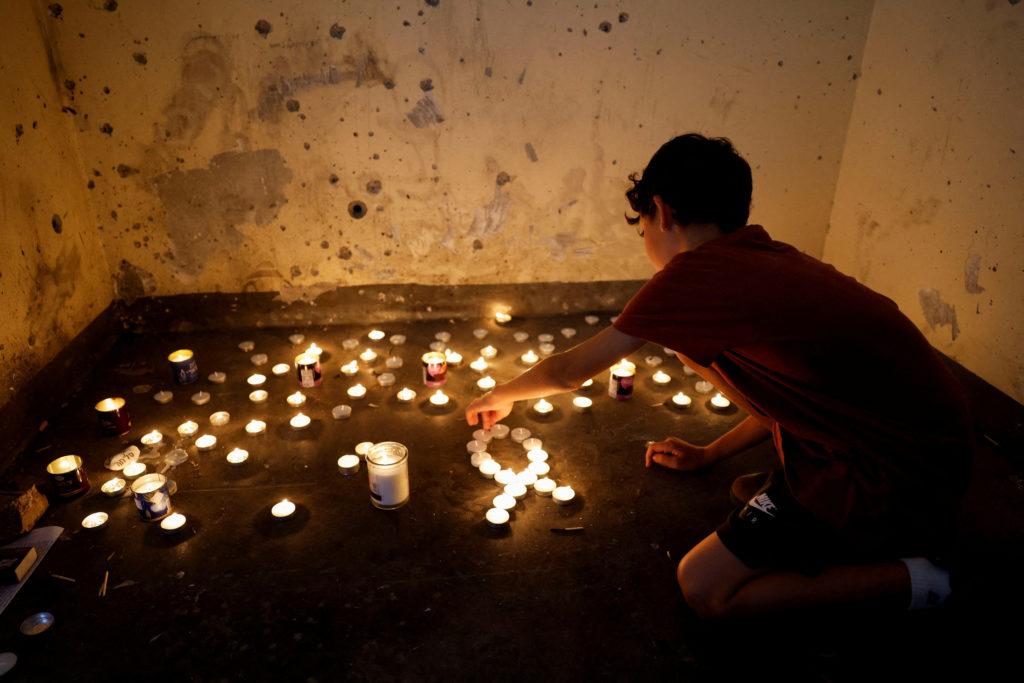
Two years ago, I woke up early on a Saturday morning to learn that a war had broken out in Israel. Hamas, the group that had controlled the Gaza Strip since 2007, launched a surprise attack into southern Israel. By the next day, we learned of its magnitude: over 1000 Israelis were killed, including more than 300 who were attending a nearby music festival. 251 were abducted and taken to Gaza as hostages. For a country as small as Israel, such numbers are almost unimaginable. Proportionally, it would mean over 40,000 Americans dead, had a similar attack taken place here – about 13 times the death toll of 9/11. The 10/7 attack was unprecedented in its scope and brutality, as evidenced by footage recorded and live-streamed by its perpetrators.
In the days following 10/7, Israel responded with air strikes on the Gaza Strip, a piece of land about 1/40 the size of Connecticut where 2.2 million people lived. The Israeli army issued evacuation orders that prompted massive movement of people to the south of the Strip, closer to the border with Egypt. Israel also amassed troops in the perimeter of the strip, eventually launching a ground assault on Gaza on Oct. 27. Since then, Israeli forces have conducted numerous operations in the Strip, which have led to massive displacement, the razing of roads and buildings, including mosques, hospitals, universities and cultural institutions, and a surging number of civilian casualties, estimated to be approaching 100,000. The war has also produced a catastrophic humanitarian crisis for its survivors in Gaza: starvation, limited access to drinking water and the spread of infectious diseases have been common.
Tragically, Israel’s war in Gaza led to the killing of many of the Israeli hostages, some by their captors, others by Israeli bombardments or in the crossfire between Israeli forces and Hamas fighters. So far, two rounds of prisoner-hostage exchange were negotiated between Israel and Hamas, via the mediation of Qatar and Egypt. Taking place in Nov. 2023 and Jan. 2025, they led to the release of all but 48 hostages, of which about 20 are believed to still be alive. The current deal the Trump administration is brokering will lead to the release of the remaining living hostages and the remains of the rest.
In Israel, the war followed months of massive protests of the government’s plan to promote judicial reform. Called “judicial coup” by its opponents – the majority of Israeli citizens – these reforms would have severely limited the power of the courts to review the executive branch’s actions or declare laws unconstitutional, turning Israel into a quasi-democracy like Hungary or Turkey. As the war progressed, the government’s authoritarian tendencies and the influence of far-right politicians within it intensified. The latter have recently vocalized positions once confined to private discourse: openly advocating for the destruction of Gaza’s infrastructure, the displacement of its Palestinian population, and the establishment of Jewish settlements in their stead. Hamas, on its end, showed no signs of willing to negotiate an end to the war that would force it to yield power in Gaza, a major Israeli demand.
This conflict has not remained confined to the Gaza Strip. A day after 10/7, Hezbollah in Lebanon – a Shia radical-Islamist group that held substantial power in the country – began firing rockets and missiles into towns in northern Israel. For the first year of the war, this reality turned northern Israel into an array of ghost towns. But in October 2024, a series of covert operations and bombings in the Lebanese capital Beirut eliminated Hezbollah’s leadership and forced it to acquiesce to Israeli and international demand to largely abandon its military tactics. The collapse of the Assad regime in Syria in late 2024 cut off Hezbollah’s lifeline coming from Iran. It also saw the installation of a new leader in Syria, the terrorist-turned-president Ahmad a-Shara, who is now negotiating directly with Israel over new security arrangements. Then came Israel’s and the US’s attack on Iran’s nuclear facilities in June of this year, made possible by Israel’s obliteration of Iran’s air defense system a year earlier. Throughout the war, the Iran-backed Houthi regime that governs most of Yemen has managed to harass Israelis with a drizzle of ballistic missiles, most of which were intercepted, and to bring to a halt a significant international shipping route by attacking ships passing in the Bab al-Mandab strait.
In the United States, the war produced escalating anti-Israeli sentiments. Demonstrations against Israel, accusing it of genocide in Gaza, erupted in multiple locations the next day – the 8th of October 2023 – while Israel was still chasing Hamas militants who infiltrated its border the previous day. These intensified, most notably on college campuses, in the coming weeks, even before Israel launched its ground offensive. College campuses, especially in the Northeast and in California, became hotbeds of such demonstrations, featuring encampments, student strikes, the taking over of academic buildings and even vandalism. Ironically, most college students demonstrating against Israel had never heard of Hamas, and have never read a book about or taken a course on Middle Eastern, Islamic, Israeli or Jewish history. On many campuses, Jewish students began to feel intimidated, and verbal and physical harassment of those who identified with Israel or just “appeared” to be Jewish intensified. Such an atmosphere was not conducive to learning and reflection that should occur at any university, especially at such sensitive moments. Fortunately, such developments largely skipped Fairfield University – a place that remains committed to free inquiry, exchange of ideas, pursuit of knowledge and being a safe and welcoming space for all students, irrespective of their race, tradition or political views.
Two years later, the war that began on 10/7 is yet to be resolved. As we watch the intricate negotiation process unfold in the coming days, it is incumbent upon us to reflect, remember, be inquisitive and open minded, and show compassion. May this year’s war anniversary also mark its end.
This is a letter to the editor. Yaron Ayalon is a Professor of Religious Studies, Carl and Dorothy Bennett Chair of Judaic Studies and Director, Bennett Center for Judaic Studies.