








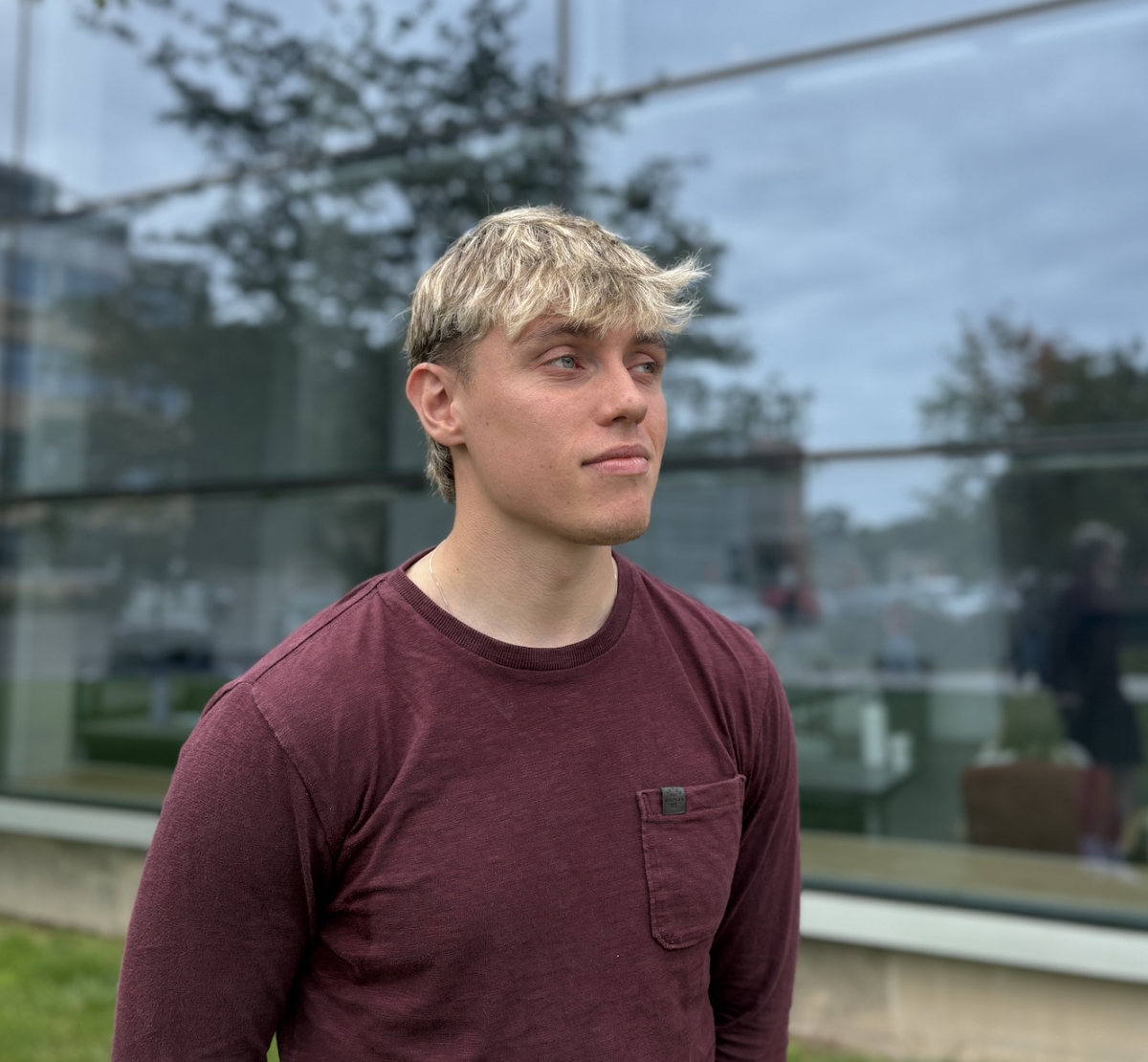
Evan Mansfield, an MBA candidate and Conlisk Scholar from the University of Limerick in Ireland, has discovered his own secret to productivity. As he adapts to life in a foreign country and seeks success in the Dolan School of Business (DSB), he leans on one tool to guide nearly every aspect of his day-to-day existence: artificial intelligence.
“I use it pretty much all the time,” he admits.
By embracing his relationship with this emerging technology and its wide-ranging capabilities, Mansfield is on track to become the first Fairfield Dolan graduate with a concentration in AI.
The AI concentration, available to students in the Master of Business Administration program, officially launched in September. However, Mansfield reveals that it has been “in the pipeline” since last year.
He was first introduced to the idea of pursuing this prospective curriculum by his course advisor, but it was Mansfield who took the initiative to explore it before it became an official offering.
“I was like, ‘Can you keep me up to date with what classes are potentially going to be considered for this?’” he recalled.
Mansfield tailored his academic schedule strategically, selecting courses that would likely align with the requirements of the concentration.
Today, his use of AI is extensive – activated within and beyond the classroom.
AI acts as his research assistant, equipped with the skills to dive deep into research as he prepares to write academic papers. It doubles as his coach, structuring workout sessions and running plans as he trains for the New York City Marathon.
In May, Mansfield participated in the 2025 StartUp Showcase. His team won both the Audience Favorite Award and the Societal Impact Award for MiniMinds, an AI-powered learning disability diagnostic tool.
Mansfield even turns to AI as a companion – a sounding board for new ideas and a listening ear to provide support as he navigates the challenges of living thousands of miles from home.
“It’s like having a friend in your pocket,” he explains. “If I am feeling a bit overwhelmed and stressed, I’ll just start talking to it if I can’t call on any of my friends.”
The use of AI as a confidant has garnered media attention over the past several months, with the increasing use of ChatGPT as a virtual therapist raising questions about the language model’s larger, and potentially catastrophic, impact on human relationships and mental health.
The New York Times published an article written by Laura Reiley, a woman who lost her daughter to suicide. The piece details how her daughter, Sophie, had confided in ChatGPT about her struggles with mental health before taking her life.
Reiley highlighted that, despite the deeply concerning nature of the messages, ChatGPT was not programmed to enact a safety plan that could have saved her daughter’s life. She expressed her fear that in unleashing A.I. companions, “we may be making it easier for our loved ones to avoid talking to humans about the hardest things” and asserted that “this is a problem that smarter minds than mine will have to solve.”
Jie Tao, DSc, director of the AI and Technology Institute at DSB, is actively researching solutions to this growing problem. He is the recipient of the Robert E. Wall Award for the 2025–26 academic year, which has fortified his leadership of the team behind KETCH: “A Knowledge-Enhanced Transformer-Based Approach to Suicidal Ideation Detection from Social Media Content.”
According to Tao, KETCH functions by “mimicking how a human counselor works by reading social media posts and looking for signals and warning signs for where intervention is needed.”
He noted that, unlike humans, AI may be unable to detect the nuance of sarcasm. To combat this, his team “did a little brain surgery on current AI” to explore the knowledge gaps of existing software.
“We’re marrying human knowledge with AI knowledge,” Tao illustrates. “Because this is a serious matter, right? We cannot just rely on some AI saying, ‘okay, I think you’re suicidal’ because that would cause lawsuits.”
The AI technology of KETCH will work in partnership with human experts. Counselors will message flagged users directly to offer support and provide an opportunity to set up a call. He envisions that the tool will not only target suicidal ideation, but will identify signs of depression, PTSD and ADHD.
Tao estimates that, out of “every 100 people our counselors reach out to, maybe 25 would actually schedule a call.”
In the future, he hopes that the number will increase. Tao underscores that KETCH’s brand identity will be the key, helping shift public perception of AI beyond the “Big Brother watching” narrative.
The motto of Fairfield’s AI and Technology Institute, “AI for the greater good,” reflects a philosophy that drives the development of KETCH and fuels Tao’s personal mission. The institute’s programming extends this mission by engaging students and the local community to foster a deeper understanding of AI’s power and potential.
“When we say ‘AI for the greater good,’ we’re not just saying it, we’re building it,” he states. “So, of course, we want help.”
Mansfield is leading the charge at Fairfield, representing the hundreds of students who are eager to integrate AI into their daily lives.
To assess student use of artificial intelligence, The Mirror conducted a poll on Fizz asking two questions: “Do you use AI every day?” and “How often do you use AI for non-academic tasks?”
As of Tuesday morning, more than 1,000 students had responded anonymously. The results showed that over half of respondents reported using AI daily and the majority said they “sometimes” use it for non-academic purposes.
David Mangini, a finance instructor and director of the MS FinTech program, recognizes the value of AI in the business world and has implemented a “wide open” policy regarding AI usage in his courses. He reminds students that they are fortunate to be “on the ground floor where this is just starting.”
Mangini puts it bluntly: “I’ve got news for you, you’re stuck with it. You’ll be with [AI] for the rest of your lives, so let’s get on board with how you’re going to use it.”
He believes that the AI concentration will play an instrumental role in preparing students for the real world, where technological sophistication is crucial.
Christopher Huntley, an associate professor of analytics, echoes Mangini’s sentiments.
“The faculty are asking more of the students now, so it’s pretty hard to get their work done without using AI,” he said.
Huntley referred to the Gartner hype cycle, a graphic representation of the maturity and adoption of new technologies. It charts the rollercoaster of public expectations – from early excitement and overhyped promise, through disappointment, to eventual maturity and practical use.
“You’re going to get lots and lots of hype,” he acknowledges. “People will say, ‘Oh my God, I need an AI degree to get a job. Then, very rapidly, that won’t be true anymore.”
But, before the downslope, Huntley foresees AI being applied to every academic program, ensuring that “it’s used and not abused by students.”
Mangini contributes to this discussion, emphasizing the fact that we have yet to reach the peak of excitement surrounding AI.
“We’re still on the upswing,” he said. “We’re still in the phase of that really exciting and expansive creativity of all the things we can do with this.”
That same excitement is alive in Mansfield. With commencement on the horizon, his accomplishments embody a new era of education, an era in which DSB is at the forefront.
He is grateful that DSB has “been on the ball,” providing rich opportunities for students to be on the cutting edge as they enter the workforce as the first digital-native generation. By working in partnership with AI, Mansfield believes it is possible to forge a path to technological advancement with an emphasis on humanity.
“AI itself isn’t going to replace your job,” Mansfield concludes. “But someone who knows how to use AI will.”