



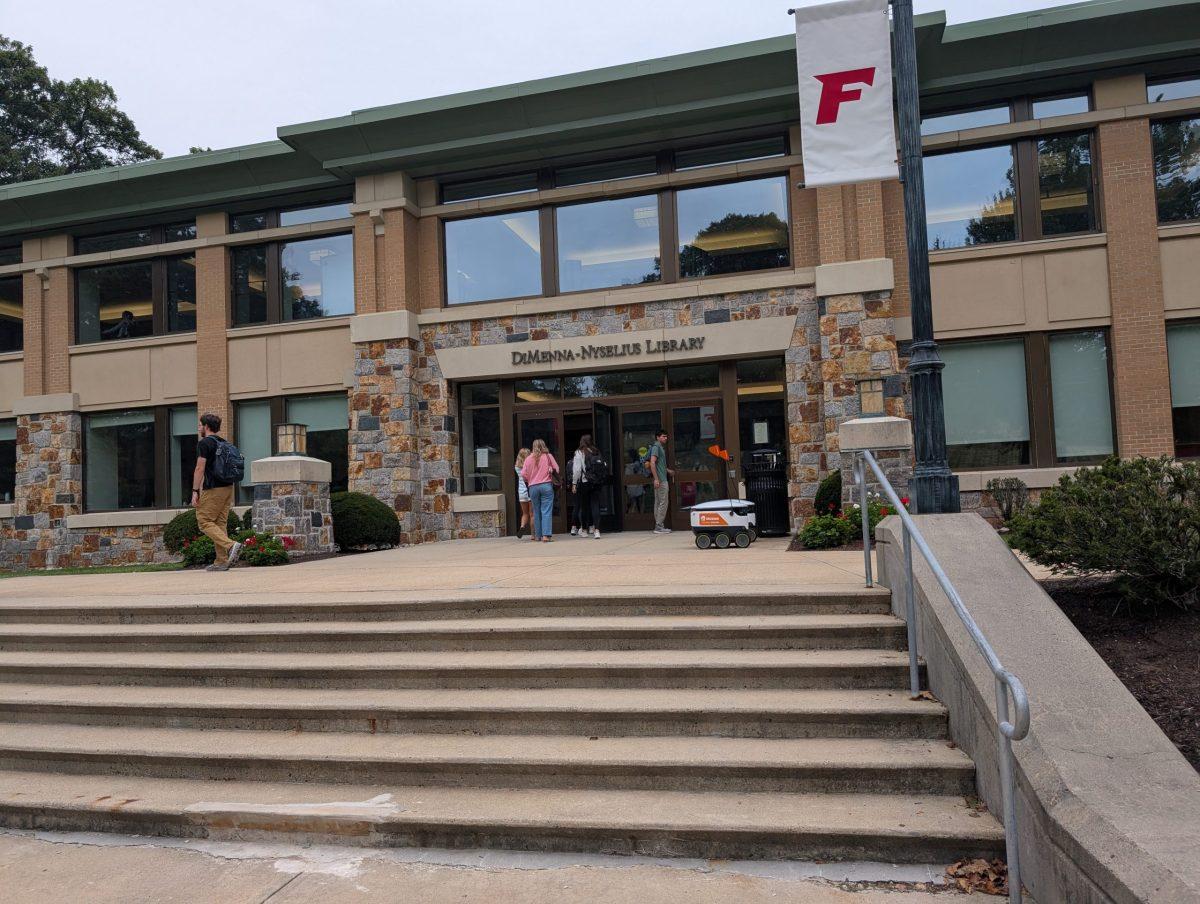
As midterm exams and projects approach, Fairfield University students are feeling the pressure. Between papers, lab reports and exam studying, students are turning to the Writing, Math and Science Centers in the DiMenna-Nyselius Library for extra help.
However, some students, especially first-year students, are unaware that these resources exist.
“I didn’t know about any of the centers,” said first-year Rowan Hoehn, a biology major. But after learning about them, she said that “the Science Center would definitely help with labs and biology classes.” She now plans to use the Science Center during this upcoming midterm season.
All three centers are located on the first floor of the library, making them convenient and easy for students to use. Students can drop in between classes or into study sessions to have extra support from the peer tutors.
The Writing Center offers tutoring for any stage of the writing process. This takes students from brainstorming ideas, outlining drafts and revising a final paper. The tutors do not edit for students by themselves but guide them in improving their writing for clarity and structure.
The Math Center provides free tutoring for first-year specific courses like pre-calculus, calculus and statistics. The center offers both drop-in hours and one-on-one appointments, which students say make it easier to get the help they need before big exams.
Anna Abel, a former math tutor and current junior, shared her experience working in the Math Center. “I was a tutor for about 2 days in the week, 2 hours each day. Some days I would not get any students, but there would be surges of students around midterm and final exams.”
She encourages students to use the Math Center as a resource, even if it is just for a quick question. “Even if they are looking for study strategies or just wanting to go over class topics they were confused on. It can be very useful if used correctly,” she said about the Math Center.
“I used that Math Center for my first calculus test,” said Maddie Cook, a current first-year student. She explained that it was really beneficial to her, so she is planning on going back for her math midterm.
The Science Center is the most recent and assists students with foundational courses such as biology, chemistry, physics, anatomy and physiology and behavioral neurosciences. While it is a useful resource, not all students have had positive experiences.
Bella Bowen, a current junior, said she used the Science Center during her first year for general biology but found that the group tutoring sessions were not as effective.
“The tutors mostly went over slides my professor had already shown,” Bowen said. “It didn’t really help with my individual questions.” Instead, she recommends more one-on-one tutoring to make the experience more personalized and maximize help.
Abigail Concaugh, also a junior, used the tutoring centers for her statistics and calculus classes in her first year. While she found them to be helpful resources and benefited from the tutoring, she said students are only able to schedule three 30-minute sessions, which she feels is not enough time.
All three centers are open to undergraduate and graduate students from any major and can assist with everything from class assignments to resumes and personal projects. Appointments can be scheduled through the library website, on the Writing, Math and Science Centers page.
As midterms start up, these tutoring centers are becoming a helpful tool for students juggling heavy workloads.