







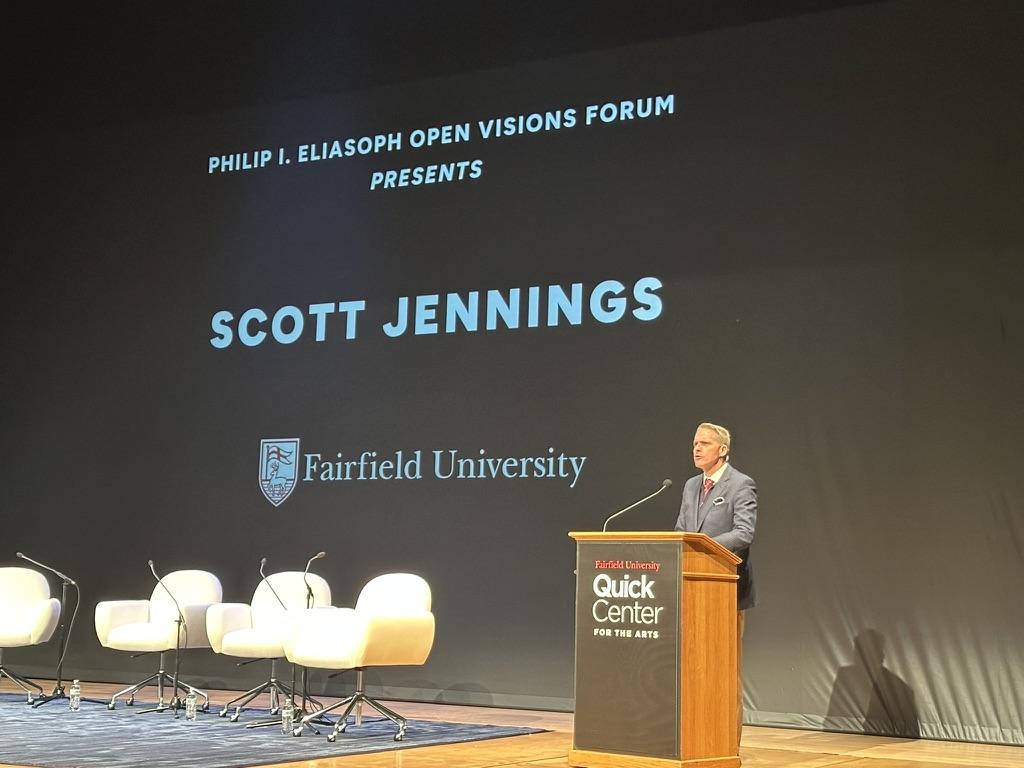
Students were urged to think critically about the forces shaping American democracy, from the influence of algorithms on public perception to the role of universities in preparing for the next generation. That was a recurring theme from Scott Jennings, CNN’s senior conservative commentator.
Speaking at Fairfield University’s Quick Center on Oct. 27, Jennings’ talk, followed by a five-person panel discussion, combined political analysis with discussion for open dialogue and civil discourse.
The audience, composed mostly of older and middle-aged people with a smaller contingent of students, nearly filled the auditorium. Their reactions reflected engagement, including nods, note-taking and laughter at some points in the event.
Jennings began his remarks by stressing the importance of open discussion as the foundation of democracy. “What we do in our politics is engage in civil discourse,” he said. “We argue, we speak, we debate, we campaign… and then we vote,” he said.
Universities, Jennings said, have drifted from their responsibilities for civic engagement. He said higher education should prepare students not only for careers but also for active, informed citizenship and American exceptionalism. “Education done right still has the power to shape a nation,” Jennings said. “Universities should be hubs of innovation, research… free speech, and where ideas can be tested.”
He referenced his late friend, Charlie Kirk, a political commentator, known for debating young people on college campuses. Jennings said the real action in politics did not start in Washington, the Green Room or on CNN, but “right here” on a college campus. Jennings said you do not need institutional permission to have a voice – only something true and the courage to say it.
He spoke about the power of algorithms and how they divide society and cause mistrust among neighbors. Regarding technology, he warned that Americans are losing a shared sense of reality because of the way social media platforms filter information. He emphasized the importance of a shared purpose requiring a shared reality.
In response to Jennings’ speech, senior Lauren Von Hassel, President of Fairfield University’s Turning Point Chapter, emphasized how his message aligns with the university’s values. “I think Jennings’ point about universities really connects to Fairfield’s Jesuit mission of developing students who think critically, lead ethically and serve responsibly,” Von Hassel said, noting programs like the Fairfield StartUp competition and interdisciplinary projects that help students apply classroom learning to real-world challenges.
Senior Sophia Haber Brock interviewed Jennings before the event and found Jennings’ talk and panel discussion insightful. She gained a new perspective on how society’s political system functions and a renewed appreciation for debate and open discussion. She added that the event made her reflect on the biases in media outlets and her own social media sources, including algorithms.
After his solo address, Jennings joined a panel discussion moderated by Dr. Philip I. Eliasoph, founder of Fairfield’s Open VISIONS Forum. The panel included Assistant Professor of the Practice Karla Barguiarena, Von Hassel and sophomore Olivia Marceda. The conversation brought generational perspectives to Jennings’ ideas, creating moments of challenge and dialogue between panel members.
As the conversation shifted from education to the broader political climate, the panel began to explore the direction of American politics and key social issues. Audience members asked questions about LGBTQ rights, the Supreme Court, active wars and immigration policy. Jennings used these opportunities to connect larger systemic issues to civic participation.
Sophomore Cayenne Coe reflected on hearing multiple perspectives on the panel. She said that hearing other perspectives on today’s news is very important to her. The panel helped her see beyond her own view and challenged what society might assume to be true. “Talking with people who see things differently also helps build trust and makes our democracy stronger,” she said.
Jennings challenged students to embrace their role in shaping democracy. He urged students to confront systemic issues and take action. “The next generation is figuring out what kind of America they want to build for themselves,” he said. His remarks throughout the night emphasized that democracy relies on citizens being willing to voice their opinions, rebuild public trust and reform institutions for the public square and the future.